Remembering Beyond the Context Window: The Capacity, Consistency, and Control Gaps in Long-Term Memory for LLM Agents
Keywords:
editing;, machine unlearning; , knowledge conflicts;, retrieval-augmented generation;, evaluation benchmarks;, data protectionAbstract
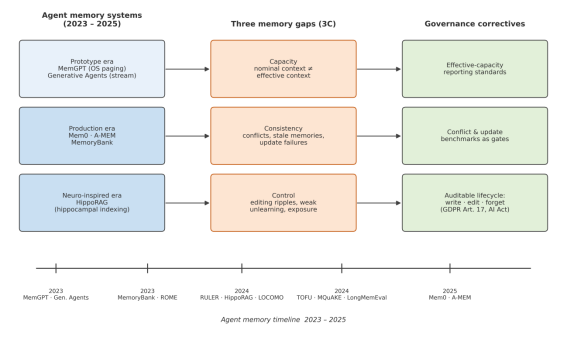
Large language model (LLM) agents are increasingly expected to remember users, tasks, and outcomes across sessions, and a dedicated memory infrastructure has emerged to meet that expectation. This survey reviews 21 core sources (2020–2025) on agent memory through an original three-gap framework—capacity (how much is retained), consistency (whether what is retained remains correct), and control (whether retention can be governed)—drawing only on peer-reviewed or publicly verifiable sources for every reported figure. The architecture side has matured rapidly across three generations: operating-system-inspired prototypes, production memory pipelines, and neurobiologically inspired retrieval. The evidence side has not kept pace. Effective context length measured by controlled benchmarks falls far below nominal context length, positional effects corrupt mid-context recall, external memories routinely conflict with parametric knowledge, and knowledge-editing procedures fail to propagate beyond the edited fact. Unlearning remains fragile exactly where retention requirements make it legally consequential. We argue that memory must be treated not as a performance feature but as an auditable record, and map the three gaps onto evaluation standards, privacy regulation, and the emerging requirements for inspectable memory lifecycles.
References
Hsieh, C.-P., Sun, S., Kriman, S., Acharya, S., Rekesh, D., Jia, F., Zhang, Y., & Ginsburg, B. (2024). RULER: What's the real context size of your long-context language models? arXiv preprint arXiv:2404.06654.
Liu, N. F., Lin, K., Hewitt, J., Paranjape, A., Bevilacqua, M., Petroni, F., & Liang, P. (2024). Lost in the middle: How language models use long contexts. Transactions of the Association for Computational Linguistics, 12, 157-173.
[3] Zhang, Z., Bo, X., Ma, C., Li, R., Chen, X., Dai, Q., Zhu, J., Dong, Z., & Wen, J.-R. (2024). A survey on the memory mechanism of large language model based agents. arXiv preprint arXiv:2404.13501.
Sumers, T. R., Yao, S., Narasimhan, K., & Griffiths, T. L. (2024). Cognitive architectures for language agents. arXiv preprint arXiv:2309.02427.
Packer, C., Wooders, S., Lin, K., Fang, V., Patil, S. G., Stoica, I., & Gonzalez, J. E. (2023). MemGPT: Towards LLMs as operating systems. arXiv preprint arXiv:2310.08560.
Park, J. S., O'Brien, J. C., Cai, C. J., Morris, M. R., Liang, P., & Bernstein, M. S. (2023). Generative agents: Interactive simulacra of human behavior. In Proceedings of the 36th Annual ACM Symposium on User Interface Software and Technology. ACM.
Chhikara, P., Khant, D., Aryan, S., Singh, T., & Yadav, D. (2025). Mem0: Building production-ready AI agents with scalable long-term memory. arXiv preprint arXiv:2504.19413.
Maharana, A., Lee, D.-H., Tulyakov, S., Bansal, M., Barbieri, F., & Fang, Y. (2024). Evaluating very long-term conversational memory of LLM agents. arXiv preprint arXiv:2402.17753.
Xu, W., Liang, Z., Mei, K., Gao, H., Tan, J., & Zhang, Y. (2025). A-MEM: Agentic memory for LLM agents. arXiv preprint arXiv:2502.12110.
Zhong, W., Guo, L., Gao, Q., Ye, H., & Wang, Y. (2024). MemoryBank: Enhancing large language models with long-term memory. arXiv preprint arXiv:2305.10250.
Lewis, P., Perez, E., Piktus, A., Petroni, F., Karpukhin, V., Goyal, N., Küttler, H., Lewis, M., Yih, W., Rocktäschel, T., Riedel, S., & Kiela, D. (2020). Retrieval-augmented generation for knowledge-intensive NLP tasks. In Advances in Neural Information Processing Systems 33.
Jiménez Gutiérrez, B., Shu, Y., Gu, Y., Yasunaga, M., & Su, Y. (2024). HippoRAG: Neurobiologically inspired long-term memory for large language models. In Advances in Neural Information Processing Systems 37.
Xie, J., Zhang, K., Chen, J., Lou, R., & Su, Y. (2024). Adaptive chameleon or stubborn sloth: Revealing the behavior of large language models in knowledge conflicts. In The Twelfth International Conference on Learning Representations (ICLR).
Wu, D., Wang, H., Yu, W., Zhang, Y., Chang, K.-W., & Yu, D. (2024). LongMemEval: Benchmarking chat assistants on long-term interactive memory. arXiv preprint arXiv:2410.10813.
Meng, K., Bau, D., Andonian, A., & Belinkov, Y. (2022). Locating and editing factual associations in GPT. In Advances in Neural Information Processing Systems 35.
Zhong, Z., Wu, Z., Manning, C. D., Potts, C., & Chen, D. (2023). MQuAKE: Assessing knowledge editing in language models via multi-hop questions. In Proceedings of the 2023 Conference on Empirical Methods in Natural Language Processing.
Maini, P., Feng, Z., Schwarzschild, A., Lipton, Z. C., & Kolter, J. Z. (2024). TOFU: A task of fictitious unlearning for LLMs. In First Conference on Language Modeling (COLM).
Carlini, N., Tramèr, F., Wallace, E., Jagielski, M., Herbert-Voss, A., Lee, K., Roberts, A., Brown, T., Song, D., Erlingsson, Ú., Oprea, A., & Raffel, C. (2021). Extracting training data from large language models. In 30th USENIX Security Symposium (pp. 2633-2650).
OpenAI. (2024). Memory FAQ. OpenAI Help Center. https://help.openai.com
European Parliament and Council. (2016). Regulation (EU) 2016/679 on the protection of natural persons with regard to the processing of personal data (General Data Protection Regulation). Official Journal of the European Union, L 119.
European Parliament and Council. (2024). Regulation (EU) 2024/1689 laying down harmonised rules on artificial intelligence (Artificial Intelligence Act). Official Journal of the European Union.