From Corpus to Model: Governing the Knowledge Supply Chain of Large Language Models
Keywords:
data provenance;, machine unlearning;, retrieval-augmented generation;, licensing;, dataset documentation; , copyrightAbstract
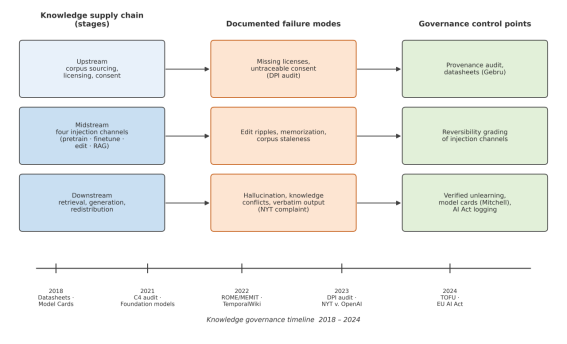
Large language models acquire most of their knowledge from sources—web corpora, licensed archives, curated datasets—whose governance traditionally depends on a capability that parametric learning destroys: the ability to take knowledge back. This survey reviews 18 core sources (2018–2024) through an original knowledge supply chain framework that traces knowledge from upstream sourcing and licensing, through midstream injection into model parameters or retrieval indexes, to downstream use and recall, with a governance control point attached to each stage; reported findings are quoted only from primary sources and court records. Three findings emerge. Upstream, the data foundation is weakly documented: large-scale audits find that most open datasets do not convey their own licensing terms, and web-scale corpora contain removed and toxic content at unrecorded rates. Midstream, the four knowledge-injection channels differ enormously in reversibility—retrieval is fully reversible, model editing partially so, pre-training effectively not at all—yet systems treat them interchangeably. Downstream, removal is the weakest control: machine unlearning remains unverified at scale exactly as litigation begins to demand it. We map documentation standards, reversibility grading, and verified deletion onto the chain's stages as actionable control points.
References
The New York Times Co. v. Microsoft Corp., No. 1:23-cv-11195 (S.D.N.Y. 2023).
Bommasani, R., Hudson, D. A., Adeli, E., Altman, R., Arora, S., von Arx, S., Bernstein, M. S., Bohg, J., Bosselut, A., Brunskill, E., Brynjolfsson, E., Buch, S., Card, D., Castellon, R., Chatterji, N., Chen, A., Creel, K., Davis, J. Q., Demszky, D., … Liang, P. (2021). On the opportunities and risks of foundation models. arXiv preprint arXiv:2108.07258.
Ji, Z., Lee, N., Frieske, R., Yu, T., Su, Y., Xu, D., Ishii, E., Bang, Y. J., Madotto, A., & Fung, P. (2023). Survey of hallucination in natural language generation. ACM Computing Surveys, 55(12), 1-38.
Longpre, S., Mahari, R., Chen, A., Obeng-Marnu, N., Sileo, D., Brannon, W., Muennighoff, N., Khazam, N., Kabbara, J., Perisetla, K., Wu, X., Shippole, E., Bollacker, K., Wu, T., Villa, L., Pentland, S., & Hooker, S. (2023). The Data Provenance Initiative: A large scale audit of dataset licensing & attribution in AI. arXiv preprint arXiv:2310.16787.
Dodge, J., Sap, M., Marasović, A., Agnew, W., Ilharco, G., Groeneveld, D., Mitchell, M., & Gardner, M. (2021). Documenting large webtext corpora: A case study on the Colossal Clean Crawled Corpus. In Proceedings of the 2021 Conference on Empirical Methods in Natural Language Processing.
Lewis, P., Perez, E., Piktus, A., Petroni, F., Karpukhin, V., Goyal, N., Küttler, H., Lewis, M., Yih, W., Rocktäschel, T., Riedel, S., & Kiela, D. (2020). Retrieval-augmented generation for knowledge-intensive NLP tasks. In Advances in Neural Information Processing Systems 33.
Meng, K., Bau, D., Andonian, A., & Belinkov, Y. (2022). Locating and editing factual associations in GPT. In Advances in Neural Information Processing Systems 35.
Meng, K., Sen Sharma, A., Andonian, A., Belinkov, Y., & Bau, D. (2023). Mass-editing memory in a transformer. In The Eleventh International Conference on Learning Representations (ICLR).
Zhong, Z., Wu, Z., Manning, C. D., Potts, C., & Chen, D. (2023). MQuAKE: Assessing knowledge editing in language models via multi-hop questions. In Proceedings of the 2023 Conference on Empirical Methods in Natural Language Processing.
Xie, J., Zhang, K., Chen, J., Lou, R., & Su, Y. (2024). Adaptive chameleon or stubborn sloth: Revealing the behavior of large language models in knowledge conflicts. In The Twelfth International Conference on Learning Representations (ICLR).
Carlini, N., Tramèr, F., Wallace, E., Jagielski, M., Herbert-Voss, A., Lee, K., Roberts, A., Brown, T., Song, D., Erlingsson, Ú., Oprea, A., & Raffel, C. (2021). Extracting training data from large language models. In 30th USENIX Security Symposium (pp. 2633-2650).
Brown, H., Lee, K., Mireshghallah, F., Shokri, R., & Tramèr, F. (2022). What does it mean for a language model to preserve privacy? In Proceedings of the 2022 ACM Conference on Fairness, Accountability, and Transparency (FAccT) (pp. 2280-2292).
Jang, J., Ye, S., Lee, C., Lee, S., Yoon, D., Seo, M., & Yang, S. (2022). TemporalWiki: A lifelong benchmark for training and evaluating ever-evolving language models. In Proceedings of the 2022 Conference on Empirical Methods in Natural Language Processing.
Maini, P., Feng, Z., Schwarzschild, A., Lipton, Z. C., & Kolter, J. Z. (2024). TOFU: A task of fictitious unlearning for LLMs. In First Conference on Language Modeling (COLM).
European Parliament and Council. (2016). Regulation (EU) 2016/679 on the protection of natural persons with regard to the processing of personal data (General Data Protection Regulation). Official Journal of the European Union, L 119.
Gebru, T., Morgenstern, J., Vecchione, B., Vaughan, J. W., Wallach, H., Daumé III, H., & Crawford, K. (2021). Datasheets for datasets. Communications of the ACM, 64(12), 86-92.
Mitchell, M., Wu, S., Zaldivar, A., Barnes, P., Vasserman, L., Hutchinson, B., Spitzer, E., Raji, I. D., & Gebru, T. (2019). Model cards for model reporting. In Proceedings of the Conference on Fairness, Accountability, and Transparency (FAT*) (pp. 220-229).
European Parliament and Council. (2024). Regulation (EU) 2024/1689 laying down harmonised rules on artificial intelligence (Artificial Intelligence Act). Official Journal of the European Union.