From Benchmark to Bedside: Mapping the Translational Gaps of Artificial Intelligence in Clinical Medicine
Keywords:
medical imaging; , large language models;, external validation;, algorithmic bias;, regulatory approvalAbstract
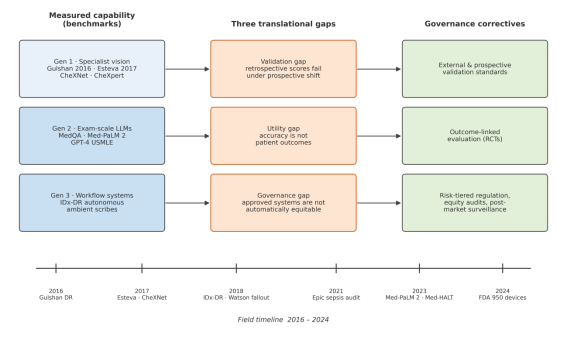
Artificial intelligence (AI) has reached specialist-level performance across a widening range of clinical tasks, yet celebrated benchmark results have repeatedly failed to translate into patient benefit. This survey reviews 29 core sources (2016–2024) through an original framework of three translational gaps—validation, utility, and governance—that jointly explain the distance between benchmark scores and bedside value; reported figures are quoted only from peer-reviewed studies, pivotal trials, or first-party regulatory documents. Capability measurement has matured across three generations—specialist image classifiers, examination-scale language models exceeding 86% on USMLE-style questions, and workflow-level deployments such as autonomous diabetic-retinopathy screening and ambient clinical documentation. Each gap independently severs the link between performance and benefit: deployed models degrade under dataset shift, an externally audited sepsis model fell far below its reported accuracy, nearly half of the citations in generated medical content can be fabricated, and human–AI collaboration can underperform either party alone. Governance responses—risk-tiered regulation, equity audits, and post-market surveillance—are converging on medicine's established logic: grading AI claims with the same evidence hierarchy that evidence-based medicine applies to therapies.
References
Topol, E. J. (2019). High-performance medicine: The convergence of human and artificial intelligence. Nature Medicine, 25(1), 44-56.
Esteva, A., Kuprel, B., Novoa, R. A., Ko, J., Swetter, S. M., Blau, H. M., & Thrun, S. (2017). Dermatologist-level classification of skin cancer with deep neural networks. Nature, 542(7639), 115-118.
Ross, C., & Swetlitz, I. (2017, September). IBM's Watson supercomputer recommended "unsafe and incorrect" treatments for cancer patients. STAT News.
Rajpurkar, P., Chen, E., Banerjee, O., & Topol, E. J. (2022). AI in health and medicine. Nature Medicine, 28(1), 31-38.
Thirunavukarasu, A. J., Ting, D. S. J., Elangovan, K., Gutierrez, L., Tan, T. F., & Ting, D. S. W. (2023). Large language models in medicine. Nature Medicine, 29(8), 1930-1940.
Kelly, C. J., Karthikesalingam, A., Suleyman, M., & Corrado, G. (2019). Key challenges for delivering clinical impact with artificial intelligence. BMC Medicine, 17(1), 195.
Gulshan, V., Peng, L., Coram, M., Stumpe, M. C., Wu, D., Narayanaswamy, A., Venugopalan, S., Widner, K., Madams, T., Cuadros, J., Kim, R., Raman, R., Nelson, P. C., Mega, J. L., & Webster, D. R. (2016). Development and validation of a deep learning algorithm for detection of diabetic retinopathy in retinal fundus photographs. JAMA, 316(22), 2402-2410.
De Fauw, J., Ledsam, J. R., Romera-Paredes, B., Nikolov, S., Tomasev, N., Blackwell, S., Askham, H., Glorot, X., O'Donoghue, B., Visentin, D., van den Driessche, G., Lakshminarayanan, B., Meyer, C., Mackinder, F., Bouton, S., Ayoub, K., Chopra, R., King, D., Karthikesalingam, A., … Ronneberger, O. (2018). Clinically applicable deep learning for diagnosis and referral in retinal disease. Nature Medicine, 24, 1342-1350.
Rajpurkar, P., Irvin, J., Zhu, K., Yang, B., Mehta, H., Duan, T., Ding, D., Bagul, A., Langlotz, C., Shpanskaya, K., Lungren, M. P., & Ng, A. Y. (2017). CheXNet: Radiologist-level pneumonia detection on chest X-rays with deep learning. arXiv preprint arXiv:1711.05225.
Irvin, J., Rajpurkar, P., Ko, M., Yu, Y., Ciurea-Ilcus, S., Chute, C., Marklund, H., Haghgoo, B., Ball, R., Shpanskaya, K., Seekins, J., Mong, D. A., Halabi, S. S., Sandberg, J. K., Jones, R., Larson, D. B., Langlotz, C. P., Patel, B. N., Lungren, M. P., & Ng, A. Y. (2019). CheXpert: A large chest radiograph dataset with uncertainty labels and expert comparison. In Proceedings of the AAAI Conference on Artificial Intelligence (Vol. 33, pp. 590-597).
Jin, D., Pan, E., Oufattole, N., Weng, W.-H., Fang, H., & Szolovits, P. (2021). What disease does this patient have? A large-scale open domain question answering dataset from medical exams. Applied Sciences, 11(14), 6421.
Singhal, K., Azizi, S., Tu, T., Mahdavi, S. S., Wei, J., Chung, H. W., Scales, N., Tanwani, A., Cole-Lewis, H., Pfohl, S., Payne, P., Seneviratne, M., Gamble, P., Kelly, C., Babiker, A., Schärli, N., Chowdhery, A., Mansfield, P., Demner-Fushman, D., … Natarajan, V. (2023). Large language models encode clinical knowledge. Nature, 620, 172-180.
Singhal, K., Tu, T., Gottweis, J., Sayres, R., Wulczyn, E., Hou, L., Clark, K., Pfohl, S., Cole-Lewis, H., Neal, D., Schaekermann, M., Wang, A., Amin, M., Lachgar, S., Mansfield, P., Prakash, S., Green, B., Dominowska, E., Aguera y Arcas, B., … Natarajan, V. (2023). Towards expert-level medical question answering with large language models. arXiv preprint arXiv:2305.09617.
Nori, H., King, N., McKinney, S. M., Carignan, D., & Horvitz, E. (2023). Capabilities of GPT-4 on medical challenge problems. arXiv preprint arXiv:2303.13375.
Kung, T. H., Cheatham, M., Medenilla, A., Sillos, C., De Leon, L., Elepaño, C., Madriaga, M., Aggabao, R., Diaz-Candido, G., Maningo, J., & Tseng, V. (2023). Performance of ChatGPT on USMLE: Potential for AI-assisted medical education using large language models. PLOS Digital Health, 2(2), e0000198.
Abràmoff, M. D., Lavin, P. T., Birch, M., Shah, N., & Webster, J. (2018). Pivotal trial of an autonomous AI-based diagnostic system for detection of diabetic retinopathy in primary care offices. npj Digital Medicine, 1, 39.
Tierney, A. A., Gayre, G., Hoberman, B., Mattern, B., Ballesca, M. A., Kipnis, P., Liu, V., & Lee, K. (2024). Ambient artificial intelligence scribes to alleviate the burden of clinical documentation. NEJM Catalyst Innovations in Care Delivery, 5(3), CAT.23.0404.
Zech, J. R., Badgeley, M. A., Liu, M., Costa, A. B., Titano, J. J., & Oermann, E. K. (2018). Variable generalization performance of a deep learning model to detect pneumonia in chest radiographs: A cross-sectional study. PLOS Medicine, 15(11), e1002683.
Wong, A., Otles, E., Donnelly, J. P., Krumm, A., McCullough, J., DeTroyer-Cooley, O., Pestrue, J., Phillips, M., Konye, J., Penoza, C., Ghous, M., & Singh, K. (2021). External validation of a widely implemented proprietary sepsis prediction model in hospitalized patients. JAMA Internal Medicine, 181(8), 1065-1070.
Finlayson, S. G., Subbaswamy, A., Singh, K., Fornage, J. F., Chodroff, L. C., Syrowatka, A., Kohane, I. S., & Saria, S. (2021). The clinician and dataset shift in artificial intelligence. New England Journal of Medicine, 385(3), 283-286.
Bhattacharyya, M., Miller, V. M., Bhattacharyya, D., & Miller, L. E. (2023). High rates of fabricated and inaccurate references in ChatGPT-generated medical content. Cureus, 15(5), e39238.
Pal, A., Umapathi, L. K., & Sankarasubbu, M. (2023). Med-HALT: Medical domain hallucination test for large language models. arXiv preprint arXiv:2307.15343.
Walters, W. H., & Wilder, E. I. (2023). Fabrication and errors in the bibliographic citations generated by ChatGPT. Scientific Reports, 13, 14045.
Lewis, P., Perez, E., Piktus, A., Petroni, F., Karpukhin, V., Goyal, N., Küttler, H., Lewis, M., Yih, W., Rocktäschel, T., Riedel, S., & Kiela, D. (2020). Retrieval-augmented generation for knowledge-intensive NLP tasks. In Advances in Neural Information Processing Systems 33.
Tschandl, P., Rinner, C., Apalla, Z., Argenziano, G., Codella, N., Halpern, A., Janda, M., Lallas, A., Longo, C., Malvehy, J., Paoli, J., Puig, S., Rosendahl, C., Soyer, H. P., Zalaudek, I., & Kittler, H. (2020). Human–computer collaboration for skin cancer recognition. Nature Medicine, 26(8), 1229-1234.
U.S. Food and Drug Administration. (2024). Artificial intelligence-enabled medical devices. U.S. FDA. https://www.fda.gov/medical-devices/software-medical-device-samd/artificial-intelligence-enabled-medical-devices
European Parliament and Council. (2024). Regulation (EU) 2024/1689 laying down harmonised rules on artificial intelligence (Artificial Intelligence Act). Official Journal of the European Union.
World Health Organization. (2021). Ethics and governance of artificial intelligence for health. WHO.
Obermeyer, Z., Powers, B., Vogeli, C., & Mullainathan, S. (2019). Dissecting racial bias in an algorithm used to manage the health of populations. Science, 366(6464), 447-453.
Downloads
Published
Versions
- 2026-09-02 (2)
- 2026-09-01 (1)