Constructing a Generative AI Framework for Personalised Instructional Resource Development: A Quasi-Experimental Evaluation in a Micro-Lecture Design and Production Course
Keywords:
generative artificial intelligence, personalised learning, instructional resource design, micro-lecture production, teacher educationAbstract
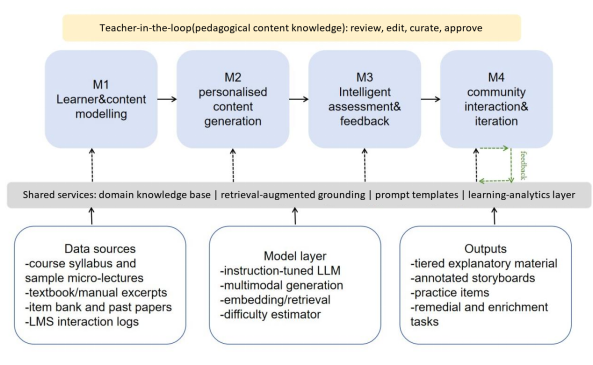
Generative artificial intelligence is promoted as a way of tailoring instruction to learners, yet most reported applications stay within language and general-education settings, and few measure outcomes in courses whose value lies in design and production skill. This paper describes a four-module generative AI framework for resource development that links learner and content modelling, generation, assessment and community iteration to a course-grounded knowledge base, with the teacher reviewing before release. It was evaluated in a twelve-week quasi-experiment in a professional core course, Micro-lecture Design and Production, at a Chinese vocational college. Two intact classes (n = 45, 44) were taught by the same instructor, who designed the framework; assignment was not random. Covariance-adjusted posttest means differed by 5.6 points (82.3 versus 76.7, p < .001, partial η² = .24), and the framework-supported class reported higher motivation and satisfaction; self-directed learning differed modestly. Preparation time per unit fell by half, though the work became more concentrated and the knowledge base carried a large one-off cost. Because the design cannot separate the framework from the additional resources it produced, the results are framed as associations rather than effects.
References
Vaswani, A., Shazeer, N., Parmar, N., Uszkoreit, J., Jones, L., Gomez, A. N., Kaiser, L., & Polosukhin, I. (2017). Attention is all you need. Advances in Neural Information Processing Systems, 30, 5998-6008. https://arxiv.org/abs/1706.03762
Brown, T. B., Mann, B., Ryder, N., Subbiah, M., Kaplan, J., Dhariwal, P., Neelakantan, A., Shyam, P., Sastry, G., Askell, A., & Amodei, D. (2020). Language models are few-shot learners. Advances in Neural Information Processing Systems, 33, 1877-1901. https://arxiv.org/abs/2005.14165
Kasneci, E., Sessler, K., Kuechemann, S., Bannert, M., Dementieva, D., Fischer, F., Gasser, U., Groh, G., Guennemann, S., Huellermeier, E., Krusche, S., Kutyniok, G., Michaeli, T., Nerdel, C., Pfeffer, J., Poquet, O., Sailer, M., Schmidt, A., Seidel, T., Stadler, M., Weller, J., Kuhn, J., & Kasneci, G. (2023). ChatGPT for good? On opportunities and challenges of large language models for education. Learning and Individual Differences, 103, 102274. https://doi.org/10.1016/j.lindif.2023.102274
Chiu, T. K. F., Xia, Q., Zhou, X., Chai, C. S., & Cheng, M. (2023). Systematic literature review on opportunities, challenges, and future research recommendations of artificial intelligence in education. Computers and Education: Artificial Intelligence, 4, 100118. https://doi.org/10.1016/j.caeai.2022.100118
UNESCO. (2023). Guidance for generative AI in education and research. Paris: UNESCO. https://unesdoc.unesco.org/ark:/48223/pf0000386693
Holmes, W., Bialik, M., & Fadel, C. (2019). Artificial intelligence in education: Promises and implications for teaching and learning. Boston, MA: Center for Curriculum Redesign. https://curriculumredesign.org/our-work/artificial-intelligence-in-education/
Celik, I., Dindar, M., Muukkonen, H., & Jaervelae, S. (2022). The promises and challenges of artificial intelligence for teachers: A systematic review of research. TechTrends, 66(4), 616-630. https://doi.org/10.1007/s11528-022-00715-y
Crompton, H., & Burke, D. (2023). Artificial intelligence in higher education: The state of the field. International Journal of Educational Technology in Higher Education, 20(1), 22. https://doi.org/10.1186/s41239-023-00392-8
Zawacki-Richter, O., Marin, V. I., Bond, M., & Gouverneur, F. (2019). Systematic review of research on artificial intelligence applications in higher education: Where are the educators? International Journal of Educational Technology in Higher Education, 16(1), 39. https://doi.org/10.1186/s41239-019-0171-0
Yan, L., Sha, L., Zhao, L., Li, Y., Martinez-Maldonado, R., Chen, G., Li, X., Jin, Y., & Gasevic, D. (2024). Practical and ethical challenges of large language models in education: A systematic scoping review. British Journal of Educational Technology, 55(1), 90-112. https://doi.org/10.1111/bjet.13370
Mishra, P., & Koehler, M. J. (2006). Technological pedagogical content knowledge: A framework for teacher knowledge. Teachers College Record, 108(6), 1017-1054. https://doi.org/10.1111/j.1467-9620.2006.00684.x
Celik, I. (2023). Towards intelligent-TPACK: An empirical study on teachers' professional knowledge to ethically integrate artificial intelligence (AI)-based tools into education. Computers in Human Behavior, 138, 107468. https://doi.org/10.1016/j.chb.2022.107468
Shieh, D. (2009). These lectures are gone in 60 seconds. The Chronicle of Higher Education, 55(26), A1, A13.
Guo, P. J., Kim, J., & Rubin, R. (2014). How video production affects student engagement: An empirical study of MOOC videos. In Proceedings of the First ACM Conference on Learning at Scale (pp. 41-50). New York, NY: ACM. https://doi.org/10.1145/2556325.2566239
Chan, C. K. Y., & Hu, W. (2023). Students' voices on generative AI: Perceptions, benefits, and challenges in higher education. International Journal of Educational Technology in Higher Education, 20(1), 43. https://doi.org/10.1186/s41239-023-00411-8
Cooper, G. (2023). Examining science education in ChatGPT: An exploratory study of generative artificial intelligence. Journal of Science Education and Technology, 32(3), 444-452. https://doi.org/10.1007/s10956-023-10039-y
Bloom, B. S. (1984). The 2 sigma problem: The search for methods of group instruction as effective as one-to-one tutoring. Educational Researcher, 13(6), 4-16. https://doi.org/10.3102/0013189X013006004
Xie, H., Chu, H.-C., Hwang, G.-J., & Wang, C.-C. (2019). Trends and development in technology-enhanced adaptive/personalized learning: A systematic review of journal publications from 2007 to 2017. Computers & Education, 140, 103599. https://doi.org/10.1016/j.compedu.2019.103599
Pane, J. F., Steiner, E. D., Baird, M. D., & Hamilton, L. S. (2017). Informing progress: Insights on personalized learning implementation and effects. Santa Monica, CA: RAND Corporation. https://www.rand.org/pubs/research_reports/RR2042.html
Zhang, L., Basham, J. D., & Yang, S. (2020). Understanding the implementation of personalized learning: A research synthesis. Educational Research Review, 31, 100339. https://doi.org/10.1016/j.edurev.2020.100339
Sweller, J., van Merrienboer, J. J. G., & Paas, F. (2019). Cognitive architecture and instructional design: 20 years later. Educational Psychology Review, 31(2), 261-292. https://doi.org/10.1007/s10648-019-09465-5
Vygotsky, L. S. (1978). Mind in society: The development of higher psychological processes. Cambridge, MA: Harvard University Press.
van Merrienboer, J. J. G., & Kirschner, P. A. (2018). Ten steps to complex learning: A systematic approach to four-component instructional design (3rd ed.). New York, NY: Routledge. https://doi.org/10.4324/9781315113210
Merrill, M. D. (2002). First principles of instruction. Educational Technology Research and Development, 50(3), 43-59. https://doi.org/10.1007/BF02505024
Mayer, R. E., & Moreno, R. (2003). Nine ways to reduce cognitive load in multimedia learning. Educational Psychologist, 38(1), 43-52. https://doi.org/10.1207/S15326985EP3801_6
Black, P., & Wiliam, D. (1998). Assessment and classroom learning. Assessment in Education: Principles, Policy & Practice, 5(1), 7-74. https://doi.org/10.1080/0969595980050102
Hattie, J., & Timperley, H. (2007). The power of feedback. Review of Educational Research, 77(1), 81-112. https://doi.org/10.3102/003465430298487
Zimmerman, B. J. (2002). Becoming a self-regulated learner: An overview. Theory into Practice, 41(2), 64-70. https://doi.org/10.1207/s15430421tip4102_2
Ji, Z., Lee, N., Frieske, R., Yu, T., Su, D., Xu, Y., Ishii, E., Bang, Y. J., Madotto, A., & Fung, P. (2023). Survey of hallucination in natural language generation. ACM Computing Surveys, 55(12), 1-38. https://doi.org/10.1145/3571730
Lewis, P., Perez, E., Piktus, A., Petroni, F., Karpukhin, V., Goyal, N., Kuttler, H., Lewis, M., Yih, W., Rocktaeschel, T., Riedel, S., & Kiela, D. (2020). Retrieval-augmented generation for knowledge-intensive NLP tasks. Advances in Neural Information Processing Systems, 33, 9459-9474. https://arxiv.org/abs/2005.11401
Wei, J., Wang, X., Schuurmans, D., Bosma, M., Ichter, B., Xia, F., Chi, E., Le, Q., & Zhou, D. (2022). Chain-of-thought prompting elicits reasoning in large language models. Advances in Neural Information Processing Systems, 35, 24824-24837. https://arxiv.org/abs/2201.11903
Pintrich, P. R., Smith, D. A. F., Garcia, T., & McKeachie, W. J. (1993). Reliability and predictive validity of the Motivated Strategies for Learning Questionnaire (MSLQ). Educational and Psychological Measurement, 53(3), 801-813. https://doi.org/10.1177/0013164493053003024
Holm, S. (1979). A simple sequentially rejective multiple test procedure. Scandinavian Journal of Statistics, 6(2), 65-70.
Braun, V., & Clarke, V. (2006). Using thematic analysis in psychology. Qualitative Research in Psychology, 3(2), 77-102. https://doi.org/10.1191/1478088706qp063oa