Microwave-Assisted Direct Fluorination of Polymers in Vibro-Fluidized Beds: From Reaction Kinetics to Reactor Design
Keywords:
Process intensification, Vibro-fluidized bed, Microwave-assisted heating, Direct fluorination, Computational fluid dynamics, Reaction kinetics, Polymer surface modificationAbstract
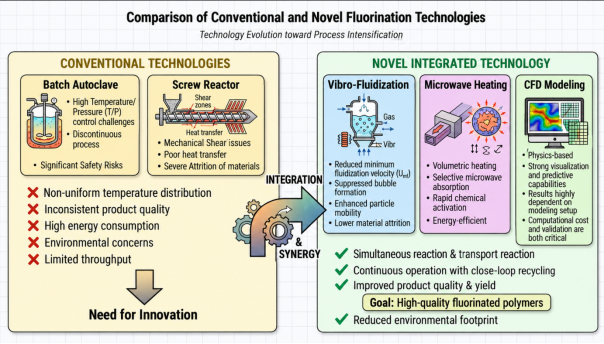
Direct fluorination of polymers is a key surface modification technology for producing high-performance fluorinated materials, but conventional batch and screw reactors face long-standing problems such as low heat transfer efficiency, severe particle attrition, and inconsistent product quality in industrial production. This paper reviews the process intensification strategy of polymer direct fluorination based on the combination of vibro-fluidized bed technology and microwave-assisted heating from the perspective of reaction engineering. The radical chain mechanism and kinetic characteristics of direct fluorination are briefly introduced, and the hydrodynamic advantages of vibro-fluidized beds in improving gas-solid contact uniformity and reducing particle attrition are analyzed. The enhancement mechanism of microwave volumetric heating on reaction kinetics and the self-regulating heating effect caused by the evolution of polymer dielectric properties are discussed. On this basis, a conceptual design of a continuous circulating vibro-fluidized bed microwave fluorination reactor with closed-loop gas purification and recycling is proposed, and its process flow, key structural modules and main operating parameters are systematically described. Finally, the main technical challenges in pilot-scale application, including particle attrition control, process safety and scale-up methods, are summarized, and corresponding future research directions are pointed out. The review can provide a reference for the upgrading and optimization of industrial polymer fluorination processes.
References
[1]Belov, N. A. (2021). Effect of direct fluorination on the transport properties and swelling of polymeric materials: A review. Polymers, 13(18), 3094.
[2]Ameduri, B. (2009). From vinylidene fluoride (VDF) to the applications of VDF-containing polymers and copolymers: recent developments and future trends. Chem. Rev., 109(12), 6632-6686.
[3]Doronin, F. A., Rytikov, G. O., Evdokimov, A. G., et al. (2023). Biostable fluorine-containing coatings on the surface of polymers. Coatings, 13(2), 424.
[4]Grand View Research. (2025). Fluorinated polymers market size, share & trends analysis report.
[5]Suchet, N., Batisse, N., Dubois, M., et al. (2025). Surface chemistry stabilization by esterification of polypropylene treated by direct fluorination. ChemPlusChem, 88(8), e202500128.
[6]Belov, N. A., Alentiev, A. Y., Bogdanova, Y. G., et al. (2020). Direct fluorination as method of improvement of operational properties of polymeric materials. Polymers, 12(12), 2836.
[7] Batisse, N., Bonnet, P., Claves, D., et al. (2025). Versatility of gas–solid fluorination for multiple functionalities. C. R. Chimie, 28(G1), 11-25.
[8]Kharitonov, A. P. (2000). Practical applications of the direct fluorination of polymers. J. Fluor. Chem., 103(2), 123-127.
[9]Kharitonov, A. P., Taege, R., Ferrier, G., et al. (2005). Direct fluorination—Useful tool to enhance commercial properties of polymer articles. J. Fluor. Chem., 126(2), 251-263.
[10]Tressaud, A., Durand, E., Labrugere, C., et al. (2007). Modification of surface properties of carbon-based and polymeric materials through fluorination routes. J. Fluor. Chem., 128, 378-391.
[11] Kunii, D., & Levenspiel, O. (1991). Fluidization Engineering (2nd ed.). Butterworth-Heinemann.
[12]Wen, Z. Q., Zhang, X. B., & Luo, Z. H. (2023). A unified CFD methodology for gas-solid fluidized beds based on the quasi-three-fluid approach. Chem. Eng. Sci., 273, 118645.
[13]Lehmann, S., Buchholz, M., Jongsma, A., et al. (2021). Modeling and flowsheet simulation of vibrated fluidized bed dryers. Processes, 9(1), 52.
[14]Mawatari, Y., Tatemoto, Y., & Noda, K. (2003). Prediction of minimum fluidization velocity for vibrated fluidized bed. Powder Technol., 131(1), 66-73.
[15] Ge, X., Zhang, J., Wang, Y., et al. (2023). Modeling and simulation of a multizone circulating reactor for polyethylene production with internal cooling. Polymers, 15(19), 3954.
[16]Li, S., & Shen, Y. (2020). Numerical study of gas-solid flow behaviors in the air reactor of coal-direct chemical looping combustion with Geldart D particles. Powder Technol., 361, 74-86.
[17]Adam, M., et al. (2024). Understanding microwave interactions with polymers to enable advanced plastic chemical recycling. Polymer Testing, 137, 108483.
[18]Kappe, C. O. (2004). Controlled microwave heating in modern organic synthesis. Angew. Chem. Int. Ed., 43(46), 6250-6284.
[19]Mingos, D. M. P., & Baghurst, D. R. (1991). Applications of microwave dielectric heating effects to synthetic problems in chemistry. Chem. Soc. Rev., 20(1), 1-47.
[20]Li, J., Huang, W., & Chen, J. (2021). Possible roadmap to advancing the knowledge system and tackling challenges from complexity. Chem. Eng. Sci., 237, 116548.
[21]Li, J., Ge, W., Zhang, J., et al. (2013). Multi-scale compromise and multi-level coarse-graining in CFD modeling of gas-solid reactors. Chem. Eng. Sci., 81, 65-74.
[22]Sundaresan, S., Ozel, A., & Kolehmainen, J. (2018). Toward constitutive models for momentum, species, and energy transport in gas-particle flows. Annu. Rev. Chem. Biomol. Eng., 9, 61-81.
[23]Song, Y., Zhou, T., Bai, R., et al. (2023). Review of CFD-DEM modeling of wet fluidized bed granulation and coating processes. Processes, 11, 382.
[24]Lagow, R. J., & Margrave, J. L. (1979). Direct fluorination: a "new" approach to fluorine chemistry. Prog. Inorg. Chem., 26, 161-210.
[25]Blinov, I. A., Mukhortov, D. A., Yampolskii, Y. P., et al. (2020). Direct fluorination of poly-2,6-dimethyl-1,4-phenylene oxide in perfluorinated liquid medium. J. Fluor. Chem., 234, 109526.
[26]Bratu, E. A., & Jinescu, G. (1971). Vibrofluidization. Rev. Roum. Chim., 16(8), 1219-1226.
[27]Geldart, D. (1973). Types of gas fluidization. Powder Technol., 7(5), 285-292.
[28]Ghadiri, M., & Zhang, Z. (2002). Impact attrition of particulate solids. Part 1: A theoretical model of chipping. Chem. Eng. Sci., 57(17), 3659-3669.
[29]Zhuang, Y. (2025). Markov-chain-based statistic model for predicting particle movement in circulating fluidized bed risers. Processes, 13(5), 5907.
[30]Metaxas, A. C., & Meredith, R. J. (1983). Industrial Microwave Heating. IET.
[31]Perreux, L., & Loupy, A. (2001). A tentative rationalization of microwave effects in organic synthesis according to the reaction medium, and mechanistic considerations. Tetrahedron, 57(45), 9199-9223.
[32]Stuerga, D., & Gaillard, P. (1996). Microwave athermal effects in chemistry: a myth's autopsy. J. Microw. Power Electromagn. Energy, 31(2), 87-100.
[33]Bradbury, M. J. (2001). Industrial applications of microwave processing. Mater. World, 9(6), 21-23.
[34]Gidaspow, D. (1994). Multiphase Flow and Fluidization: Continuum and Kinetic Theory Descriptions. Academic Press.
[35]Corcoles, J. I., Acosta-Iborra, A., Almendros-Ibanez, J. A., et al. (2021). Numerical simulation of a 3-D gas-solid fluidized bed: Comparison of TFM and CPFD numerical approaches and experimental validation. Adv. Powder Technol., 32(10), 3689-3705.
[36]Tian, Y., Lu, B., Li, F., et al. (2020). A steady-state EMMS drag model for fluidized beds. Chem. Eng. Sci., 219, 115616.
[37]Nikolopoulos, A., Stroggylidis, A., Alobaid, F., et al. (2023). Development of an artificial neural network EMMS drag model for the simulation of fluidized beds in chemical looping combustion. Chem. Eng. Sci., 281, 119424.
[38]Salman, A. D., & Hounslow, M. J. (2004). Particle breakage. Powder Technol., 143-144, 1.
[39]Fulchini, F., Nan, W., Ghadiri, M., et al. (2017). CFD-DEM analysis of particle attrition in a jet in a fluidised bed. EPJ Web Conf., 140, 07017.
[40]Goh, W. P., & Ghadiri, M. (2025). DEM simulation of particle attrition in mechanofusion device. Powder Technol., 456, 120822.
[41]Zhou, T., & Li, H. (2015). Mesoscale structures in fluidized beds. Adv. Powder Technol., 26(3), 673-684.
[42]Wang, W., & Li, J. (2022). Exploring a unified EMMS drag model for gas-solid fluidization. Chem. Eng. Sci., 258, 117766.
[43]ANSYS Inc. (2021). ANSYS Fluent User's Guide (Release 2021 R2).
[44]Xie, N., Battaglia, F., & Pannala, S. (2008). Effects of using two-versus three-dimensional computational modeling of fluidized beds: Part I, hydrodynamics. Powder Technol., 182(1), 1-13.
[45]Sim, Y., Park, S., Kim, S., et al. (2024). Process intensification for enhanced fluoride removal and recovery as calcium fluoride using a fluidized bed reactor. Int. J. Mol. Sci., 25(9), 4646.
[46]Xi, K., Kovar, T. M., Fullmer, W. D., et al. (2021). CFD-DEM study of bubble properties in a cylindrical fluidized bed of Geldart Group D particles and comparison with prior MRI data. Powder Technol., 389, 75-84.
[47]Paavani, K., Agarwal, K., Alam, S. S., et al. (2025). Advances in plastic to fuel conversion: reactor design, operational optimization, and machine learning integration. Sustainable Energy & Fuels, 9, 54-71.
[48]Farizhandi, A. A. K., Zhao, H., & Lau, R. (2016). Modeling the change in particle size distribution in a gas-solid fluidized bed due to particle attrition using a hybrid artificial neural network-genetic algorithm approach. Chem. Eng. Sci., 155, 210-220.