Dynamic Optimization of AI-Enabled Supply Chains under Demand and Disruption Uncertainty: A Distributional Forecasting and Model-Predictive Control Approach
Keywords:
Artificial Intelligence, Supply Chain Management, Dynamic Optimization, Stochastic Model Predictive Control, Reinforcement Learning, Disruption riskAbstract
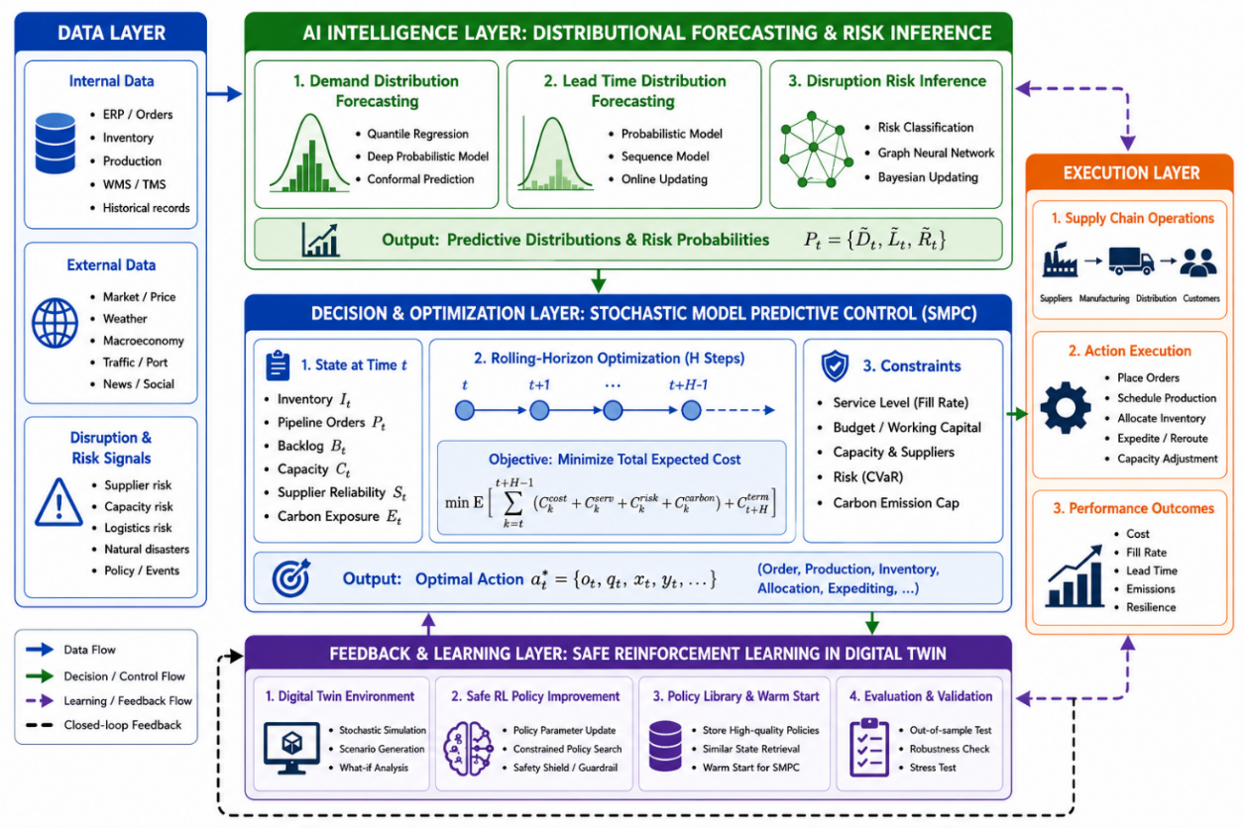
Supply chains are sequential decision systems in which procurement, production, inventory positioning, allocation and expediting decisions are repeatedly adjusted under demand volatility, lead-time uncertainty and disruption risk. Artificial intelligence has improved the quality of forecasts and early-warning signals, yet prediction alone does not determine an operational policy. This study develops an artificial-intelligence-enabled dynamic optimization model for supply chain management. The model treats inventory, pipeline orders, backlog, capacity, supplier reliability and carbon exposure as evolving state variables. A distributional learning layer updates demand, lead-time and disruption beliefs from operational data, while a rolling-horizon stochastic model-predictive controller selects feasible actions under cost, service, resilience and sustainability constraints. safe policy-improvement mechanism based on Constrained Proximal Policy Optimization (C-PPO) is further introduced to tune policy parameters in a digital twin without relaxing managerial constraints. A reproducible numerical experiment with 1,000 simulated demand-disruption scenarios shows that the proposed AI-enabled dynamic optimization model reduces total cost by 55.3% relative to a static base-stock benchmark, maintains a fill rate of 0.983, and lowers emissions relative to a conventional stochastic AI-MPC design. The results indicate that the managerial value of AI in supply chain management depends less on isolated forecasting accuracy than on the closed-loop conversion of predictive distributions into constrained sequential decisions.
References
H. Min. Artificial intelligence in supply chain management: Theory and applications. International Journal of Logistics Research and Applications, vol. 13, no. 1, pp. 13-39, 2010.
G. Wang, A. Gunasekaran, E. W. T. Ngai, and T. Papadopoulos. Big data analytics in logistics and supply chain management: Certain investigations for research and applications. International Journal of Production Economics, vol. 176, pp. 98-110, 2016.
D. Ivanov. Predicting the impacts of epidemic outbreaks on global supply chains: A simulation-based analysis on the coronavirus outbreak. Transportation Research Part E, vol. 136, Article 101922, 2020.
D. Ivanov and A. Dolgui. OR-methods for coping with the ripple effect in supply chains during COVID-19 pandemic: Managerial insights and research implications. International Journal of Production Economics, vol. 232, Article 107921, 2021.
C. S. Tang. Perspectives in supply chain risk management. International Journal of Production Economics, vol. 103, no. 2, pp. 451-488, 2006.
L. V. Snyder and Z.-J. M. Shen, Fundamentals of Supply Chain Theory, 2nd ed. Hoboken, NJ: Wiley, 2019.
S. Axsater, Inventory Control, 3rd ed. Cham: Springer, 2015.
W. B. Powell. Reinforcement Learning and Stochastic Optimization: A Unified Framework for Sequential Decisions. Hoboken, NJ: Wiley, 2022.
R. Bellman. Dynamic Programming. Princeton. NJ: Princeton University Press, 1957.
D. P. Bertsekas. Dynamic Programming and Optimal Control, 4th ed. Belmont, MA: Athena Scientific, 2017.
C. E. Garcia, D. M. Prett, and M. Morari. Model predictive control: Theory and practice - A survey. Automatica, vol. 25, no. 3, pp. 335-348, 1989.
D. Bertsimas and A. Thiele. A robust optimization approach to inventory theory. Operations Research, vol. 54, no. 1, pp. 150-168, 2006.
W. Klibi, A. Martel, and A. Guitouni. The design of robust value-creating supply chain networks: A critical review. European Journal of Operational Research, vol. 203, no. 2, pp. 283-293, 2010.
J. Gijsbrechts, R. N. Boute, J. A. Van Mieghem, and D. J. Zhang. Can deep reinforcement learning improve inventory management? Performance and implementation of dual sourcing-mode problems. Manufacturing & Service Operations Management, vol. 24, no. 3, pp. 1349-1368, 2022.
B. Rolf, I. Jackson, M. Muller, S. Lang, T. Reggelin, and D. Ivanov. A review on reinforcement learning algorithms and applications in supply chain management. International Journal of Production Research, vol. 61, no. 20, pp. 7151-7179, 2023.
R. S. Sutton and A. G. Barto. Reinforcement Learning: An Introduction, 2nd ed. Cambridge, MA: MIT Press, 2018.
R. Fildes, S. Ma, and S. Kolassa. Retail forecasting: Research and practice. International Journal of Forecasting, vol. 38, no. 4, pp. 1283-1318, 2022.
S. Makridakis, E. Spiliotis, and V. Assimakopoulos. M5 accuracy competition: Results, findings, and conclusions. International Journal of Forecasting, vol. 38, no. 4, pp. 1346-1364, 2022.
B. Wilder, B. Dilkina, and M. Tambe. Melding the data-decisions pipeline: Decision-focused learning for combinatorial optimization. Proceedings of the AAAI Conference on Artificial Intelligence, vol. 33, no. 1, pp. 1658-1665, 2019.
M. Christopher and H. Peck. Building the resilient supply chain. The International Journal of Logistics Management, vol. 15, no. 2, pp. 1-14, 2004.
H. L. Lee. The triple-A supply chain. Harvard Business Review, vol. 82, no. 10, pp. 102-112, 2004.
M. S. Sodhi and C. S. Tang. Supply chain management for extreme conditions: Research opportunities. Journal of Supply Chain Management, vol. 57, no. 1, pp. 7-16, 2021.
R. Dekker, J. Bloemhof, and I. Mallidis. Operations research for green logistics - An overview of aspects, issues, contributions and challenges. European Journal of Operational Research, vol. 219, no. 3, pp. 671-679, 2012.
S. Seuring and M. Muller. From a literature review to a conceptual framework for sustainable supply chain management. Journal of Cleaner Production, vol. 16, no. 15, pp. 1699-1710, 2008.
F. Sahin and E. P. Robinson. Flow coordination and information sharing in supply chains: Review, implications, and directions for future research. Decision Sciences, vol. 33, no. 4, pp. 505-536, 2002.