Empirical Evaluation of Artificial Intelligence Transfer Learning in Data-Constrained Dementia Screening: Analyzing Overfitting and Representation Collapse on Brain MRI
Keywords:
Dementia Screening; Brain MRI; Transfer Learning; Overfitting; Mode Collapse; ResNet18; MobileNetV2.Abstract
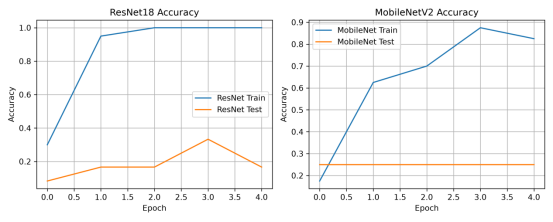
Early screening and precise staging of dementia, particularly Alzheimer’s Disease (AD), are vital for implementing timely clinical and lifestyle interventions. While deep convolutional neural networks (CNNs) have shown significant promise in structural magnetic resonance imaging (sMRI) computer-aided diagnosis, their generalization robustness remains a critical vulnerability in data-constrained clinical fine-tuning scenarios. This paper investigates the comparative learning dynamics and failure modes of two representative vision backbones—a standard residual network (ResNet18) and a lightweight architecture (MobileNetV2)—on a four-class dementia classification task (Mild Demented, Moderate Demented, Non-Demented, and Very Mild Demented) under constrained data regimes. Empirical results demonstrate severe generalization divergence across both architectures: ResNet18 exhibited unconstrained empirical memorization, achieving 100.0% training accuracy while degrading to 16.67% on unseen test instances. Conversely, MobileNetV2 suffered from complete representation collapse; despite reaching 82.50% training accuracy, its test accuracy plateaued at exactly 25.00% across all epochs, with confusion matrix profiling revealing that 100% of test predictions collapsed into the single Mild Demented category. Qualitative trajectory and error-matrix analyses confirm that generic pre-trained weights without domain-adapted regularization are highly prone to capturing non-pathological imaging artifacts or falling into trivial local optima in ultra-low data regimes. These findings highlight critical risks of decision collapse in deploying lightweight deep models for point-of-care dementia screening and underscore the imperative for domain-specific self-supervised pre-training and robust class-balancing protocols.
References
[1]Burnham, S. C., et al. (2019). Application of the NIA-AA Research Framework: Towards a Biological Definition of Alzheimer's Disease using Cerebrospinal Fluid Biomarkers in the AIBL Study. Journal of Prevention of Alzheimer's Disease, 6(4), 248-255. https://doi.org/10.14283/jpad.2019.25.
[2]Wisch, J. K., et al. (2025). Cross-Sectional Comparison of Structural MRI Markers of Impairment in a Diverse Cohort of Older Adults. Human Brain Mapping, 46(2), e70133. https://doi.org/10.1002/hbm.70133.
[3]Tanveer, M., et al. (2020). Machine Learning Techniques for the Diagnosis of Alzheimer's Disease: A Review. ACM Transactions on Multimedia Computing, Communications, and Applications, 16(1), 30. https://doi.org/10.1145/3344998.
[4]Rao, B. S., Aparna, M., Kolisetty, S. S., Janapana, H., & Koteswararao, Y. V. (2024). Multi-class Classification of Alzheimer's Disease Using Deep Learning and Transfer Learning on 3D MRI Images. Traitement du Signal, 41(3), 1397-1404. https://doi.org/10.18280/ts.410328.
[5]Saratxaga, C. L., et al. (2021). MRI Deep Learning-Based Solution for Alzheimer's Disease Prediction. Journal of Personalized Medicine, 11(9), 932. https://doi.org/10.3390/jpm11090902.
[6]Gao, Y. Q., & Mosalam, K. M. (2020). PEER Hub ImageNet: A Large-Scale Multiattribute Benchmark Data Set of Structure Images. Journal of Structural Engineering, 146(10), 04020198. https://doi.org/10.1061/(asce)st.1943-541x.0002745.
[7]Ebrahimi, M. S., & Abadi, H. K. (2021). Study of Residual Networks for Image Recognition. In Lecture Notes in Networks and Systems (Vol. 284, pp. 754-763). Springer. https://doi.org/10.1007/978-3-030-80126-7_53.
[8]Howard, A., et al. (2019). Searching for MobileNetV3. In Proceedings of the IEEE/CVF International Conference on Computer Vision (ICCV) (pp. 1314-1324). IEEE. https://doi.org/10.1109/iccv.2019.00140.
Downloads
Published
Issue
Section
License
Copyright (c) 2026 Yuling Li, Yiti Huang, Shuangli Wu

This work is licensed under a Creative Commons Attribution 4.0 International License.