Flexible blank removal robot for ceramic production line
Keywords:
Slip Casting, Robotic Grasping, Vacuum End Effector, Harmonic Drive, Structural SimulationAbstract
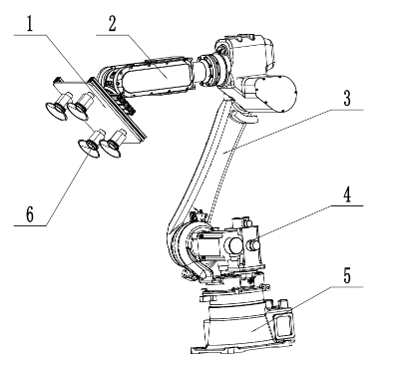
The manual handling of wet ceramic greenware after slip casting results in low efficiency, high breakage rates, and harsh labor conditions. To address these issues, this paper presents the design and simulation of a flexible greenware-picking robot tailored for slip casting production lines. An articulated rotary coordinate structure with six degrees of freedom is adopted. Key components including the forearm, wrist, and rotary base are designed and calculated. A vacuum suction cup matrix is selected as the end effector, and a harmonic reducer is integrated for precise torque transmission. A digital prototype is constructed using SolidWorks, followed by kinematic and force simulations. Simulation results verify that the robot achieves a stable grasping force of 350 N distributed across four suction cups, a rated payload of 5 kg, and positioning accuracy of ±3–5 mm. The robot operates within a workspace of 2500 mm × 1200 mm × 1100 mm and meets the cycle time requirements of typical slip casting lines. This work provides a verified paradigm for robotic automation in the ceramic industry.
References
Bellifemine, F., Poggi, A., & Rimassa, G. (2000). Developing multi-agent systems with JADE. International Workshop on Agent Theories, Architectures, and Languages, 89-103.
Hei, Z. R. (2024). Research on intelligent modification of ceramic production equipment based on robotic technology. Foshan Ceramics, 34(11), 65-67.
Li, H., Zhou, L., & Chen, Y. D. (2024). Discussion on the application of industrial robot technology in ceramic industry. Ceramic Science and Art, 58(08), 70-71.
Li, H., Zhou, L., & Liu, X. W. (2024). Research on industrial robot control in ceramic glazing process based on time scale. Ceramic Science and Art, 58(06), 32-33.
Chen, J. F. (2024). Simulation of robotic glazing thickness and trajectory optimization for sanitary ceramics (Master's thesis). North China University of Science and Technology.
Zhang, Y. (2024). Research on automatic planning algorithm of robotic grinding path for ceramic sanitary ware greenware based on 3D vision (Master's thesis). Guangdong University of Technology.
Liu, B. (2023). Development and application of single chip microcomputer in sanitary ceramic glazing robot. Ceramic Science and Art, 57(10), 101.
Gao, Y. (2023). Research on reconfigurable miniature piezoelectric robot with built-in piezoelectric ceramics (Doctoral dissertation). Harbin Institute of Technology.
Hong, Z. J. (2022). Design and control of robotic constant force actuator for polishing sanitary ceramic greenware (Master's thesis). Foshan University.
Zhenhao, S., et al. (2025). Machine learning-assisted design of Al2O3-SiO2 porous ceramics. Journal of Advanced Materials, 42(3), 211-218.