Sino-European Trade Flow Forecasting and Path Optimization: A GFIITL-DCL-MHA Framework Based on Deep Collaborative Learning and Transfer Learning
Keywords:
Sino-European Trade, Flow Forecasting, Multi-Head Attention, Particle Swarm Optimization, Transfer Learning, GFIITL FrameworkAbstract
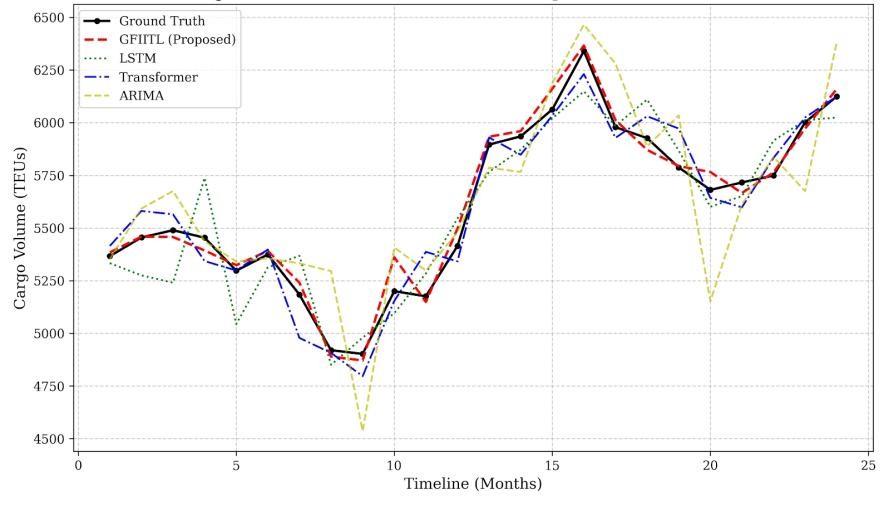
To address the challenges of macroeconomic volatility and "cold start" issues in Sino-European trade, this paper proposes the innovative GFIITL-DCL-MHA framework. This framework integrates a Multi-Head Attention (MHA) mechanism for feature collaboration and Particle Swarm Optimization (PSO) for global hyperparameter calibration. Empirical analysis conducted on trade data from 2021 to 2024 demonstrates that the framework achieves a superior Mean Absolute Percentage Error (MAPE) of 3.48%, significantly outperforming standard benchmark models. By leveraging the transfer learning module, the model achieves stable convergence in only 15 epochs, representing a 70.0% increase in training efficiency for data-sparse routes. Furthermore, with a high AUC of 0.92 for risk detection, the framework successfully optimized complex logistics paths, reducing the average transit time from 18.5 days to 14.2 days while lowering overall operational costs by 13.5%. These empirical results provide a robust, data-driven scientific basis for significantly enhancing the overall resilience and efficiency of the "Belt and Road" logistics network in an increasingly uncertain global environment.
References
Si, C., Guan, R., & Leou, E. C. H. (2025). China-Europe Railway Express: The Establishment of the New Euro-Asia Link. In The Palgrave Handbook on China-Europe-Africa Relations (pp. 301-320). Singapore: Springer Nature Singapore.
Xie, R., Chen, H., & Nash, C. (2002). Migration of railway freight transport from command economy to market economy: the case of China. Transport Reviews, 22(2), 159-177.
Xu, X., Chase, N., & Peng, T. (2021). Economic structural change and freight transport demand in China. Energy Policy, 158, 112567.
Ma, Y., Geng, X., & Wang, J. (2020). A deep neural network with multiplex interactions for cold-start service recommendation. IEEE Transactions on Engineering Management, 68(1), 105-119.
Abbasi, M., Farokhnia, A., Bahreinimotlagh, M., & Roozbahani, R. (2021). A hybrid of Random Forest and Deep Auto-Encoder with support vector regression methods for accuracy improvement and uncertainty reduction of long-term streamflow prediction. Journal of Hydrology, 597, 125717.
Shankar, S., Ilavarasan, P. V., Punia, S., & Singh, S. P. (2020). Forecasting container throughput with long short-term memory networks. Industrial management & data systems, 120(3), 425-441.
Brauwers, G., & Frasincar, F. (2021). A general survey on attention mechanisms in deep learning. IEEE transactions on knowledge and data engineering, 35(4), 3279-3298.
Franceschi, L., Donini, M., Perrone, V., Klein, A., Archambeau, C., Seeger, M., ... & Frasconi, P. (2025). Hyperparameter optimization in machine learning. Foundations and Trends® in Machine Learning, 18(6), 975-1109.
Tsantis, A., Mangan, J., Calatayud, A., & Palacin, R. (2022). Container shipping: a systematic literature review of themes and factors that influence the establishment of direct connections between countries. Maritime Economics & Logistics, 1.
Ohakwe, C. R., & Wu, J. (2025). The impact of macroeconomic indicators on logistics performance: A comparative analysis using simulated scenarios. Sustainable Futures, 9, 100567.
Ning, J., Huang, W., Ma, H., Wu, M., Hu, Y., & Shi, D. (2026). A Partition Collaborative Prediction Method for Wind Farm Cluster Based on Multi–Scale Component Reconstruction and Fusion Technology. Journal of Electrical Engineering & Technology, 1-17.
Xuhong, T., Zhou, J., Shengjie, H., Sun, Y., & Luo, K. (2025). Survey on Multi-Source Data Based Application and Exploitation Toward Smart Ship Navigation. Journal of Marine Science and Engineering, 13(10), 1852.
Yanhua, P. (2025). RESEARCH ON THE OFDI RISK OF CHINESE ENTERPRISES IN EU COUNTRIES UNDER THE BELT AND ROAD INITIATIVE. Evija Kļave, 77.
Li, S., Guo, L., Zhu, J., Chen, J., Liu, M., Cui, X., & Li, L. (2025). Medium-term offshore wind speed multi-step forecasting based on VMD and GRU-MATNet model. Ocean Engineering, 325, 120737.
Ning, J., & Huang, W. (2025). An Ultra-Short-Term Wind Power Prediction Model Based on Crested Porcupine Optimizer and Cross-Domain Attention Mechanism. International Journal of Advanced AI Applications, 1(8), 1-21.
Guo, D., Li, Z., & Tao, T. (2025). Bio-Inspired Adaptive Dynamic Attention: An Empirically Driven AI Framework for Human–Machine Coaching in Team Collaborative Decision-Making. International Journal of Advanced AI Applications, 1(8), 22-38.
Xu, Y., Hu, C., Wu, Q., Jian, S., Li, Z., Chen, Y., ... & Wang, S. (2022). Research on particle swarm optimization in LSTM neural networks for rainfall-runoff simulation. Journal of hydrology, 608, 127553.
Cheng, J., Chen, J., Yang, Z., & Lian, F. (2025). Resilience analysis of the sino-european trade transportation networks: The role of the New western land-sea corridor. Transportation Research Part E: Logistics and Transportation Review, 201, 104284.
Zeng, Q., Lu, T., Lin, K. C., Yuen, K. F., & Li, K. X. (2020). The competitiveness of Arctic shipping over Suez Canal and China-Europe railway. Transport Policy, 86, 34-43.
Liao, Z. M., Zhao, Z., Chen, L. B., Wan, Z. H., Liu, N. S., & Lu, X. Y. (2023). Reduced-order variational mode decomposition to reveal transient and non-stationary dynamics in fluid flows. Journal of Fluid Mechanics, 966, A7.
Veglianti, E., Li, Y., Magnaghi, E., & De Marco, M. (2022). Understanding artificial intelligence: insights on China. Journal of Asia Business Studies, 16(2), 324-339.
Fu, Y., Yang, Z., Quek, T. Q., & Yang, H. H. (2021). Towards cost minimization for wireless caching networks with recommendation and uncharted users’ feature information. IEEE Transactions on Wireless Communications, 20(10), 6758-6771.
Liu, Y., Xing, W., Lin, M., Liu, Y., & Chow, T. W. (2024). A new classification method for diagnosing COVID-19 pneumonia via joint parallel deformable MLP modules and bi-LSTM with multi-source generated data of CXR images. IEEE Transactions on Consumer Electronics, 70(1), 2794-2805.
Mumtahina, U., Alahakoon, S., & Wolfs, P. (2024). Hyperparameter tuning of load-forecasting models using metaheuristic optimization algorithms—a systematic review. Mathematics, 12(21), 3353.
Wang, X., & Guo, D. (2026). Adaptive-Gated Spiking Neural Networks with Memristive Crossbars for Real-Time Athlete Injury Prediction. International Journal of Advanced AI Applications, 2(1), 1-16.
Zhu, J., Chen, X., Diao, H., Li, S., He, J. Y., Li, C., ... & Lu, H. (2025). Exploring dynamic transformer for efficient object tracking. IEEE Transactions on Neural Networks and Learning Systems.