A Generative AI–Supported Instructional Model for Statistical Modeling in Undergraduate Probability and Statistics
Keywords:
Probability and statistics, Statistical modeling, Generative AI, Instructional scaffoldingAbstract
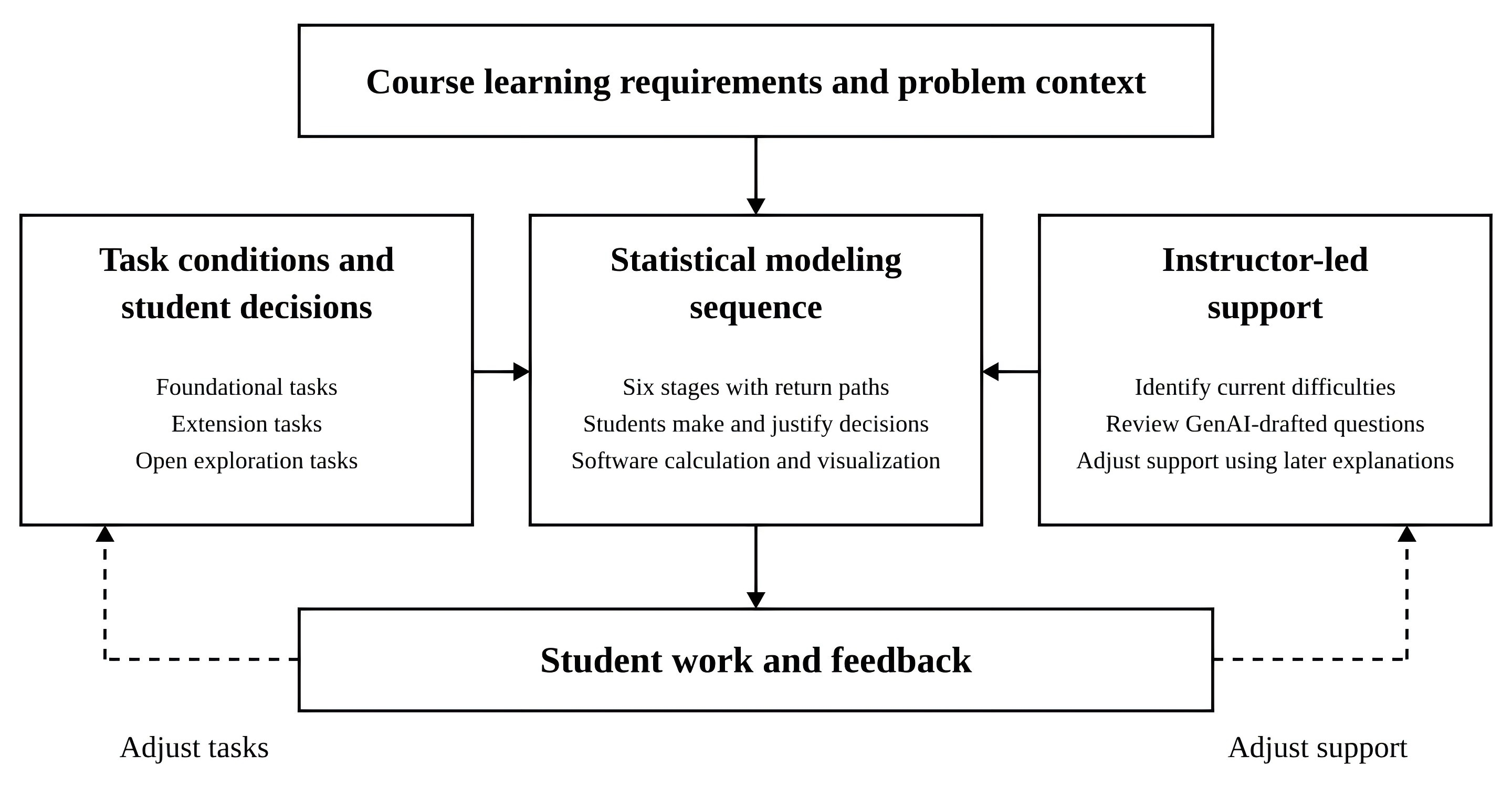
This instructional design article proposes a six-stage model for undergraduate probability and statistics. It asks how a modeling unit can connect calculations under a specified model with statistical decisions when data definitions change, and how instructors can adjust support using students’ initial responses and explanations of revisions. For each stage, the model specifies what students submit, what instructors check, and when students revisit an earlier decision. Instructors use generative AI (GenAI) only to draft follow-up questions for their review. Students respond to those questions without interacting with GenAI. A worked example shows how students move from a Poisson probability calculation to an order-level comparison using constructed logistics complaint records. The example also shows how instructors use students’ explanations to decide whether to reduce prompts or revisit an earlier stage. Classroom feasibility and effects on student learning remain to be evaluated.
References
[1]GAISE College Report ASA Revision Committee. (2016). Guidelines for assessment and instruction in statistics education college report 2016. American Statistical Association. https://www.amstat.org/asa/files/pdfs/GAISE/GaiseCollege_Full.pdf
[2]Phadke, S., Beckman, M., & Lock Morgan, K. (2024). Examining the role of context in statistical literacy assessment. Statistics Education Research Journal, 23(1), Article 4. https://doi.org/10.52041/serj.v23i1.529
[3]Ellis, A. R., & Slade, E. (2023). A new era of learning: Considerations for ChatGPT as a tool to enhance statistics and data science education. Journal of Statistics and Data Science Education, 31(2), 128–133. https://doi.org/10.1080/26939169.2023.2223609
[4]Xing, Y. (2024). Exploring the use of ChatGPT in learning and instructing statistics and data analytics. Teaching Statistics, 46(2), 95–104. https://doi.org/10.1111/test.12367
[5]Schwarz, J. (2025). The use of generative AI in statistical data analysis and its impact on teaching statistics at universities of applied sciences. Teaching Statistics, 47(2), 118–128. https://doi.org/10.1111/test.12398
[6]Bien, J., & Mukherjee, G. (2025). Generative AI for Data Science 101: Coding without learning to code. Journal of Statistics and Data Science Education, 33(2), 129–142. https://doi.org/10.1080/26939169.2024.2432397
[7]Bray, R. L. (2025). A tutorial on teaching data analytics with generative AI. INFORMS Journal on Applied Analytics, 55(4), 319–343. https://doi.org/10.1287/inte.2023.0053
[8]Rao, V. N. V., Jeng, A., Drew, J., Kala, B., & Gongati, S. (2026). Students’ statistical thinking when using generative AI: A descriptive case study. Journal of Statistics and Data Science Education, 34(1), 4–15. https://doi.org/10.1080/26939169.2025.2596684
[9]Al Labadi, L., & Ly, A. (2025). Enhancing statistics education through project-based learning (PBL) and the emergence of ChatGPT. Teaching Statistics, 47(3), 200–218. https://doi.org/10.1111/test.12405
[10]Al Labadi, L., Ly, A., & Kirusheva, S. (2026). Student perceptions of AI and virtual populations in a project-based experimental design course. Teaching Statistics. Advance online publication. https://doi.org/10.1002/test.70043
[11]Levine, R. A. (2026). Facilitating a collaborative relationship between generative AI and the statistics student. The American Statistician, 80(3), 360–371. https://doi.org/10.1080/00031305.2025.2608724
[12]Williams, K. Z., & Rudchenko, T. (2026). Transformative teaching in management statistics: Integrating real-world experiences and artificial intelligence. Decision Sciences Journal of Innovative Education, 24(1-2), Article e70019. https://doi.org/10.1111/dsji.70019
[13]Ugrinowitsch, C., & Libardi, C. A. (2026). From gatekeeper to architect: Operationalizing AI as a cognitive partner in higher education. Frontiers in Education, 11, Article 1880704. https://doi.org/10.3389/feduc.2026.1880704
[14]Zhang, J. (2026). Scaffolding probabilistic reasoning in civil engineering education: Integrating AI tutoring with simulation-based learning. Education Sciences, 16(1), Article 103. https://doi.org/10.3390/educsci16010103
[15]Pittard, M., Saidi, R., Bargagliotti, A., & Malone, C. (n.d.). Recommendation 1. Guidelines for Assessment and Instruction in Statistics College Report. https://amstat.quarto.pub/college-gaise/recommendations/recommendation-01.html
[16]Wild, C. J., & Pfannkuch, M. (1999). Statistical thinking in empirical enquiry. International Statistical Review, 67(3), 223–248. https://doi.org/10.1111/j.1751-5823.1999.tb00442.x
[17]van de Pol, J., Volman, M., & Beishuizen, J. (2010). Scaffolding in teacher–student interaction: A decade of research. Educational Psychology Review, 22(3), 271–296. https://doi.org/10.1007/s10648-010-9127-6
[18]Miao, F., & Holmes, W. (2023). Guidance for generative AI in education and research. UNESCO. https://www.unesco.org/en/articles/guidance-generative-ai-education-and-research
[19]NIST/SEMATECH. (n.d.). Poisson distribution. In e-Handbook of statistical methods. Retrieved November 11, 2026, from https://itl.nist.gov/div898/handbook/eda/section3/eda366j.htm
[20]DeLuca, L. S., Reinhart, A., Weinberg, G., Laudenbach, M., Miller, S., & Brown, D. W. (2025). Developing students’ statistical expertise through writing in the age of AI. Journal of Statistics and Data Science Education, 33(3), 266–278. https://doi.org/10.1080/26939169.2025.2497547
[21]Alkhasawneh, S. N., Lampropoulos, G., & Hernández-Leo, D. (2025). Generative AI in learning design: A systematic review. In A. I. Cristea, E. Walker, Y. Lu, O. C. Santos, & S. Isotani (Eds.), Artificial intelligence in education: 26th international conference, AIED 2025, Palermo, Italy, July 22–26, 2025, proceedings, part IV (pp. 17–30). Springer. https://doi.org/10.1007/978-3-031-98459-4_2
[22]Pereira, E., Nsair, S., Pereira, L. R., & Grant, K. (2024). Constructive alignment in a graduate-level project management course: An innovative framework using large language models. International Journal of Educational Technology in Higher Education, 21, Article 25. https://doi.org/10.1186/s41239-024-00457-2
[23]Xi, L., Zhang, Y., & Wang, Q. (2026). Investigating the effects of an LLM-based Socratic conversational agent on students’ academic performance and reflective thinking in higher education. Computers & Education, 241, Article 105494. https://doi.org/10.1016/j.compedu.2025.105494
[24]Xia, Q., Yang, Y., Wang, W., & Yin, H. (2026). Promoting interdisciplinary learning with generative AI through self-regulated scaffolding. Journal of Computer Assisted Learning, 42(2), Article e70214. https://doi.org/10.1002/jcal.70214
[25]Melanou, C., & Beege, M. (2026). Scaffolding generative AI as a tutor: A quasi-experimental study of learning outcomes and motivational, cognitive and metacognitive processes. Education Sciences, 16(4), Article 651. https://doi.org/10.3390/educsci16040651
Downloads
Published
Issue
Section
License
Copyright (c) 2027 Wen Zhong, Yan Ze Teh

This work is licensed under a Creative Commons Attribution 4.0 International License.