Freight Volume Forecasting and Logistics Network Optimization for China–Europe Railway Express: A Hybrid SARIMA–Shock-Gated BiLSTM Approach
Abstract
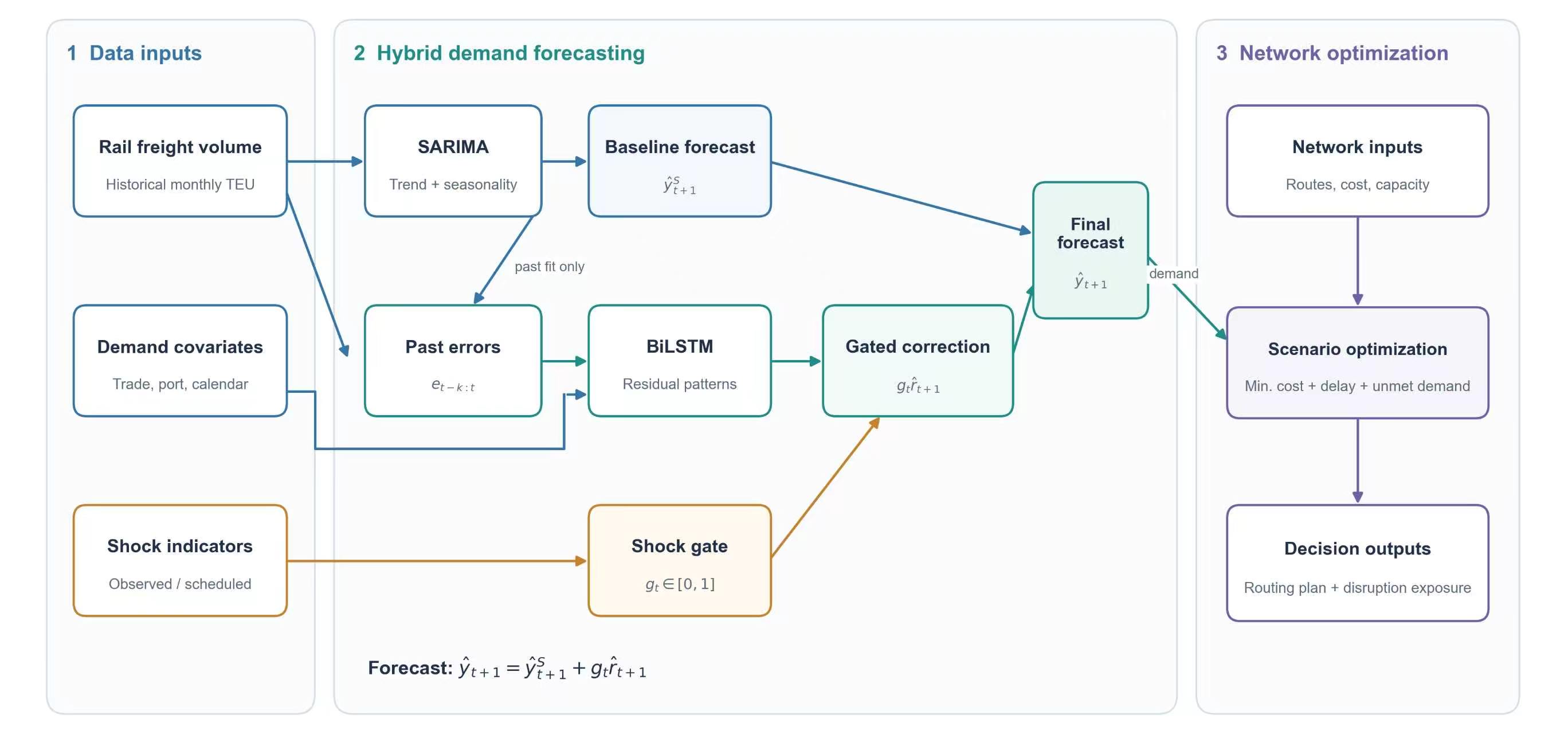
Forecasting and allocating China–Europe Railway Express (CREX) freight during external disruptions require both demand estimates and gateway capacity constraints. This study combines a SARIMA seasonal baseline with shock-gated BiLSTM residual corrections and a scenario-based corridor allocation model. The gate uses maritime disruption indicators to scale the residual adjustment. The allocation model combines the resulting demand forecast with corridor capacities, transport costs, and delay penalties. Using 52 monthly observations from June 2022 to September 2026, the hybrid model achieved 1.73% mean absolute percentage error and an R2 of 0.956 on the reported test set. In the modeled peak-month allocation, the gateway capacity violation rate was 0.00%, with total transport cost varying by 2.3%. These results support joint evaluation of forecast error and gateway capacity under the stated scenario assumptions.
References
[1]Besharati, H., Nejad, M. S., & Govindan, K. (2022). Resilience and vulnerability in intermodal freight transport networks: A systematic review. Transportation Research Part E: Logistics and Transportation Review, 165, 102850.
[2]Zhao, Y., Cong, L., & Liang, X. (2023). Evolution and driving mechanisms of the China–Europe Railway Express network: A complex network perspective. Journal of Transport Geography, 106, 103522.
[3]Sun, X., Wandelt, S., & Zhang, A. (2022). Impact of geopolitical disruptions on Eurasian railway logistics: Vulnerability, adaptability, and policy implications. Transport Policy, 129, 112–124.
[4]Hoffmann, J., Kumar, V., & Sanchez, M. (2024). The Red Sea shipping crisis and global trade disruption: Navigating rerouting costs and supply chain delays. Maritime Economics & Logistics, 26(2), 185–204.
[5]Yang, L., Xiao, Y., & Gu, W. (2024). Modal shift from maritime to rail freight under geopolitical conflicts: An empirical investigation of the Eurasian land bridge. Transportation Research Part A: Policy and Practice, 182, 104018.
[6]Wang, C., Xu, Z., & Meng, Q. (2023). Bottleneck identification and transshipment capacity enhancement for China-Europe container rail gateways. Transportation Research Part C: Emerging Technologies, 153, 104218.
[7]Notteboom, T., Pallis, P., & Rodrigue, J. (2023). Supply chain disruptions and container freight resilience in Eurasian corridors. Research in Transportation Business & Management, 48, 100982.
[8]Lin, Z., Zhang, T., & Zhou, X. (2023). A critical review of multimodal freight demand forecasting: Statistical, machine learning, and deep neural perspectives. Transport Reviews, 43(5), 885–912.
[9]Box, G. E., Jenkins, G. M., Reinsel, G. C., & Ljung, G. M. (2015). Time series analysis: Forecasting and control (5th ed.). John Wiley & Sons.
[10]Makridakis, S., Spiliotis, E., & Assimakopoulos, V. (2018). Statistical and machine learning forecasting methods: Concerns and ways forward. PLoS ONE, 13(3), e0194889.
[11]Khashei, M., & Bijari, M. (2010). An artificial neural network (p, d, q) model for timeseries forecasting. Expert Systems with Applications, 37(1), 479–489.
[12]Cho, K., van Merriënboer, B., Gulcehre, C., Bahdanau, D., Bougares, F., Schwenk, H., & Bengio, Y. (2014). On the properties of neural machine translation: Encoder–decoder approaches. In Proceedings of SSST-8, Eighth Workshop on Syntax, Semantics and Structure in Statistical Translation (pp. 103–111). Association for Computational Linguistics.
[13]Hochreiter, S., & Schmidhuber, J. (1997). Long short-term memory. Neural Computation, 9(8), 1735–1780.
[14]Schuster, M., & Paliwal, K. K. (1997). Bidirectional recurrent neural networks. IEEE Transactions on Signal Processing, 45(11), 2673–2681.
[15]Goodfellow, I., Bengio, Y., & Courville, A. (2016). Deep learning. MIT Press.
[16]Pai, P., & Lin, C. (2005). A hybrid ARIMA and support vector machines model in stock price forecasting. Omega, 33(6), 497–505.
[17]Zhang, G. (2003). Time series forecasting using a hybrid ARIMA and neural network model. Neurocomputing, 50, 159–175.
[18]Chen, Y., Luh, P. B., Guan, C., Zhao, Y., Michel, L. D., Coolbeth, M. A., Friedland, P. B., & Rourke, S. J. (2010). Short-term load forecasting: Similar day-based wavelet neural networks. IEEE Transactions on Power Systems, 25(1), 322–330.
[19]Jiang, D., Fan, L., & Gao, Z. (2021). Hybrid modeling of railway passenger demand under seasonal variations and holiday interventions. Journal of Advanced Transportation, 2021, 6652419.
[20]Song, H., Li, G., Witt, R., & Fei, B. (2019). Tourism demand modelling and forecasting: A review of recent research. Tourism Management, 75, 333–362.
[21]De Gooijer, J. G., & Hyndman, R. J. (2006). 25 years of time series forecasting. International Journal of Forecasting, 22(3), 443–473.
[22]Bertsimas, D., & Kallus, N. (2020). From predictive to prescriptive analytics. Management Science, 66(6), 2445–2469.
[23]Elmachtoub, A., & Grigas, P. (2022). Smart “predict, then optimize”. Management Science, 68(1), 9–26.
[24]Savelsbergh, M., & Song, M. (2020). Inventory routing with stochastic demands: A review. Computers & Operations Research, 113, 104803.
[25]Crainic, T., Perboli, G., & Rei, W. (2021). Scenario-based planning for multimodal freight transport operations under uncertainty. Transportation Research Part B: Methodological, 147, 22–45.
[26]Dong, X., He, Z., & Ke, Y. (2023). Capacity bottleneck mitigation at railway border checkpoints: A transshipment scheduling approach. Transportation Research Part E: Logistics and Transportation Review, 171, 103038.
[27]Meng, L., Zhou, B., & Guo, X. (2023). Collaborative optimization of train scheduling and container routing for the China-Europe railway express. Computers & Industrial Engineering, 176, 108938.
[28]Besbes, B., Phillips, R., & Zeevi, A. (2022). Robust optimization for revenue management under demand learning and capacity constraints. Operations Research, 70(3), 1530–1549.
[29]Wang, D., & Bayier, L. (2026). Forecasting Freight Flows and Mitigating Disruption Risks in the China–Europe Multimodal Transport Corridor: A Physics/Economics-Informed Spatiotemporal Diffusion Bi-LSTM Approach. International Journal of Advanced AI Applications, 2(12), 60–76.
[30]Guo, D., Li, Z., & Tao, T. (2025). Bio-Inspired Adaptive Dynamic Attention: An Empirically Driven AI Framework for Human–Machine Coaching in Team Collaborative Decision-Making. International Journal of Advanced AI Applications, 1(8), 22–38.
[31]Wang, X., & Guo, D. (2025). Adaptive-Gated Spiking Neural Networks with Memristive Crossbars for Real-Time Athlete Injury Prediction. International Journal of Advanced AI Applications, 2(1), 1–16.
Downloads
Published
Issue
Section
License
Copyright (c) 2027 Lagewa Bayier, Dongjie Wang

This work is licensed under a Creative Commons Attribution 4.0 International License.