Forecasting Freight Flows and Mitigating Disruption Risks in the China–Europe Multimodal Transport Corridor: A Physics/Economics-Informed Spatiotemporal Diffusion Bi-LSTM Approach
Keywords:
China-Europe Railway Express, Spatiotemporal Graph Neural Network, Bi-LSTM, Supply Chain Disruption Risk, Economic Mechanism ConstraintsAbstract
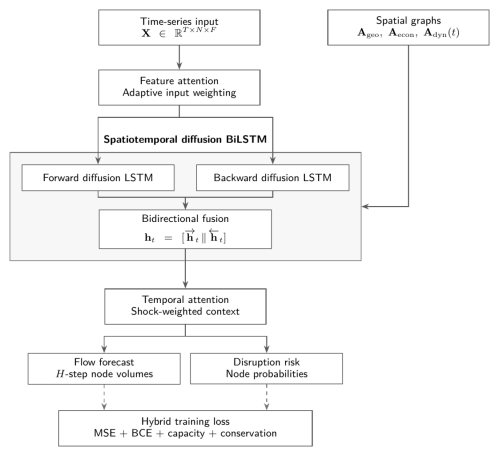
We develop ST-Diff-BiLSTM to forecast node-level freight flows and classify disruption risk in the China–Europe multimodal corridor. The model combines geographic, trade, and flow-based graph links with feature and temporal attention. Its loss includes capacity and flow-balance penalties. In the reported test split, MAE was 8.4 TEU, compared with 17.8 TEU for baseline LSTM; the capacity-overrun rate was 0.1%, compared with 4.8%. The disruption classifier reached an AUC of 0.941. These results describe the reported dataset and simulation settings; broader operational performance requires external validation.
References
[1]Qian, P., Yang, Z., & Lian, F. (2024). The structural and spatial evolution of the China Railway Express network. Research in Transportation Economics, 103, 101414. https://doi.org/10.1016/j.retrec.2024.101414.
[2]He, Z., Navneet, K., Van Dam, W., et al. (2021). Robustness assessment of multimodal freight transport networks. Reliability Engineering & System Safety, 207, 107315. https://doi.org/10.1016/j.ress.2020.107315.
[3]Notteboom, T., Pallis, T., & Rodrigue, J. P. (2021). Disruptions and resilience in global container shipping and ports: The COVID-19 pandemic versus the 2008–2009 financial crisis. Maritime Economics & Logistics, 23, 179–210. https://doi.org/10.1057/s41278-020-00180-5.
[4]Wang, B., Su, Q., & Chin, K. S. (2021). Vulnerability assessment of China–Europe Railway Express multimodal transport network under cascading failures. Physica A: Statistical Mechanics and its Applications, 584, 126359. https://doi.org/10.1016/j.physa.2021.126359.
[5]European Parliament and Council of the European Union (2023). Regulation (EU) 2023/956 of 10 May 2023 establishing a carbon border adjustment mechanism. Official Journal of the European Union, L 130, 52–104. https://eur-lex.europa.eu/eli/reg/2023/956/oj.
[6]Hilmola, O. P., & Li, W. (2023). Drivers of railway container transports between China and Finland. Journal of Shipping and Trade, 8, 22. https://doi.org/10.1186/s41072-023-00151-y.
[7]Anselin, L. (1988). Spatial Econometrics: Methods and Models. Dordrecht: Kluwer Academic Publishers. https://doi.org/10.1007/978-94-015-7799-1.
[8]Lv, Y., Duan, Y., Kang, W., et al. (2015). Traffic flow prediction with big data: A deep learning approach. IEEE Transactions on Intelligent Transportation Systems, 16(2), 865–873. https://doi.org/10.1109/TITS.2014.2345663.
[9]Hochreiter, S., & Schmidhuber, J. (1997). Long short-term memory. Neural Computation, 9(8), 1735-1780.
[10]Ma, X., Tao, Z., Wang, Y., et al. (2015). Long short-term memory neural network for traffic speed prediction using remote microwave sensor data. Transportation Research Part C: Emerging Technologies, 54, 187–197. https://doi.org/10.1016/j.trc.2015.03.014.
[11]Ke, G. Y., & Verma, M. (2021). A framework to managing disruption risk in rail-truck intermodal transportation networks. Transportation Research Part E: Logistics and Transportation Review, 153, 102340. https://doi.org/10.1016/j.tre.2021.102340.
[12]Yu, B., Yin, H., & Zhu, Z. (2018). Spatio-temporal graph convolutional networks: A deep learning framework for traffic forecasting. In Proceedings of the 27th International Joint Conference on Artificial Intelligence (IJCAI) (pp. 3634-3640).
[13]Li, Y., Yu, R., Shahabi, C., et al. (2018). Diffusion convolutional recurrent neural network: Data-driven traffic forecasting. In International Conference on Learning Representations (ICLR).
[14]Karpatne, A., Atluri, G., Faghmou, P. R., et al. (2017). Theory-guided data science: A new paradigm for scientific discovery from data. IEEE Transactions on Knowledge and Data Engineering, 29(10), 2318-2331.
[15]Wang, X., & Guo, D. (2025). Adaptive-Gated Spiking Neural Networks with Memristive Crossbars for Real-Time Athlete Injury Prediction. International Journal of Advanced AI Applications, 2(1), 1–16.
[16]Guo, D., Li, Z., & Tao, T. (2025). Bio-Inspired Adaptive Dynamic Attention: An Empirically Driven AI Framework for Human–Machine Coaching in Team Collaborative Decision-Making. International Journal of Advanced AI Applications, 1(8), 22–38.
[17]Wu, Z., Pan, S., Long, G., et al. (2019). Graph WaveNet for deep spatial-temporal graph modeling. In Proceedings of the 28th International Joint Conference on Artificial Intelligence (pp. 1907–1913). https://doi.org/10.24963/ijcai.2019/264.
[18]Guo, S., Lin, Y., Feng, N., et al. (2019). Attention based spatial-temporal graph convolutional networks for traffic flow forecasting. In Proceedings of the AAAI Conference on Artificial Intelligence (pp. 922–929). https://doi.org/10.1609/aaai.v33i01.3301922.
[19]Bai, L., Yao, L., Li, C., et al. (2020). Adaptive graph convolutional recurrent network for traffic forecasting. In Advances in Neural Information Processing Systems (pp. 17804–17815).
[20]Lim, B., Arik, S. Ö., Loeff, N., et al. (2021). Temporal Fusion Transformers for interpretable multi-horizon time series forecasting. International Journal of Forecasting, 37(4), 1748–1764. https://doi.org/10.1016/j.ijforecast.2021.03.012.
[21]Zheng, C., Fan, X., Wang, C., & Qi, J. (2020). GMAN: A graph multi-attention network for traffic prediction. In Proceedings of the AAAI Conference on Artificial Intelligence (pp. 1234–1241). https://doi.org/10.1609/aaai.v34i01.5477.
[22]Zhou, H., Zhang, S., Peng, J., et al. (2021). Informer: Beyond efficient transformer for long sequence time-series forecasting. In Proceedings of the AAAI Conference on Artificial Intelligence (pp. 11106–11115). https://doi.org/10.1609/aaai.v35i12.17325.
[23]Nie, Y., Nguyen, N. H., Sinthong, P., & Kalagnanam, J. (2023). A time series is worth 64 words: Long-term forecasting with transformers. In International Conference on Learning Representations. https://openreview.net/forum?id=Jbdc0vTOcol.
[24]Zhou, X., Sun, J., Fu, H., et al. (2024). Resilience analysis of the integrated China-Europe freight transportation network under heterogeneous demands. Transportation Research Part A: Policy and Practice, 186, 104130. https://doi.org/10.1016/j.tra.2024.104130.
[25]Rodrigue, J. P. (2020). The Geography of Transport Systems (5th ed.). New York: Routledge.
[26]Kipf, T. N., & Welling, M. (2017). Semi-supervised classification with graph convolutional networks. In International Conference on Learning Representations (ICLR).
[27]Anderson, J. E., & Van Wincoop, E. (2003). Gravity with gravitas: A solution to the border puzzle. American Economic Review, 93(1), 170-192.
[28]Qin, Y., Song, D., Chen, H., et al. (2017). A dual-stage attention-based recurrent neural network for time series prediction. In Proceedings of the 26th International Joint Conference on Artificial Intelligence (IJCAI) (pp. 2627-2633).
[29]Raissi, M., Perdikaris, P., & Karniadakis, G. E. (2019). Physics-informed neural networks: A deep learning framework for solving forward and inverse problems involving nonlinear partial differential equations. Journal of Computational Physics, 378, 686-707.
[30]Ahuja, R. K., Magnanti, T. L., & Orlin, J. B. (1993). Network Flows: Theory, Algorithms, and Applications. Englewood Cliffs: Prentice Hall.