Generative AI as Cultural Intermediary: Meaning Shift and the Redistribution of Intermediary Rights in Cross-Cultural Translation of AI Music
Keywords:
Generative AI, cultural intermediary, transcultural music translation, prompt audit, intermediary rightsAbstract
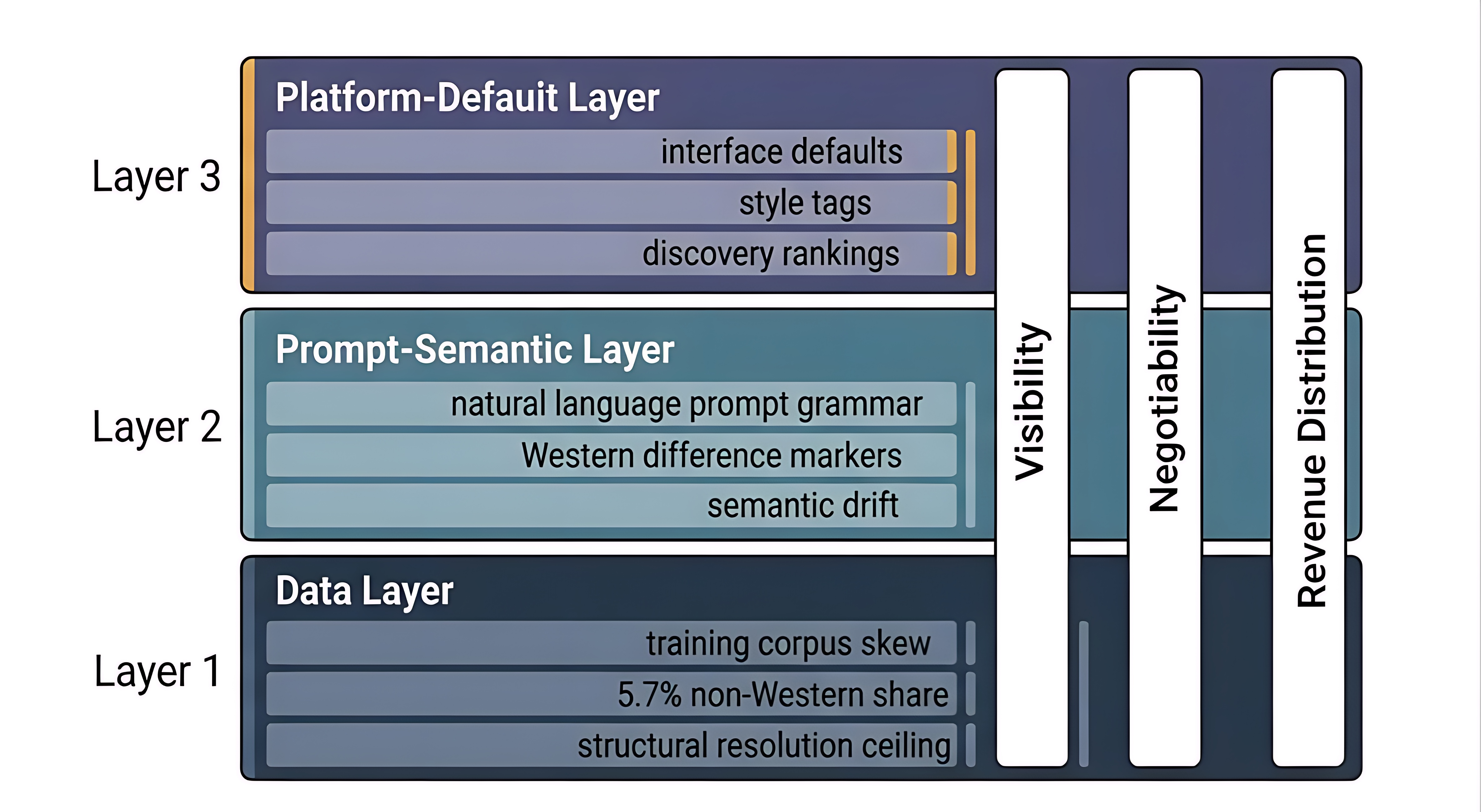
Generative music systems are increasingly consequential intermediaries in cross-cultural music circulation, yet existing research has neither theorised how AI intermediaries differ from human and institutional ones, nor explained the mechanisms behind AI-mediated meaning shift and the redistribution of intermediary power. This paper proposes an analytical framework of generative cultural intermediation and uses prompt auditing as its core method, combined with platform content analysis and intermediary interviews, to examine the meaning-production logic of Suno and Udio in cross-cultural music translation. Meaning shift is not incidental bias but a systematic outcome at three nested levels — data distribution, prompt semantics and platform defaults — through which non-Western music is translated into Western-recognisable difference markers rather than represented as a performance system of its own. Intermediary power migrates from human curators to a model–platform complex that operates invisibly. The core issue of AI music governance is therefore not transparency or copyright alone, but who holds the structural intermediary position in cross-cultural meaning production and whether that position can be negotiated.
References
[1]Hesmondhalgh, D. (2019) The cultural industries (4th ed.). SAGE.
[2]Bourdieu, P. (1984). Distinction: A social critique of the judgement of taste. Harvard University Press.
[3]Negus, K. (2002) The work of cultural intermediaries and the enduring distance between production and consumption. Cultural Studies, 16(4), 501-515.
[4]Copet, J., Kreuk, F., Gat, I., Remez, T., Kant, D., Synnaeve, G., Adi, Y., & Défossez, A. (2023). Simple and controllable music generation. In Advances in Neural Information Processing Systems 36 (pp. 47704-47720).
[5]Casini, L., Vila, C. L., Dalmazzo, D., Kaila, A.-K., & Sturm, B. L. T. (2025). Data-driven analysis of text-conditioned AI-generated music: A case study with Suno and Udio. arXiv preprint.
[6]Campbell, C., Sands, S. & Mavrommatis, A. (2026). The paradoxes of generative AI-mediated acculturation. International Marketing Review. https://doi.org/10.1108/imr-10-2025-0569
[7]Mehta, A., Chauhan, S., Djanibekov, A., Kulkarni, A., Xia, G., & Choudhury, M. (2025). Music for all: Representational bias and cross-cultural adaptability of music generation models. In Findings of the Association for Computational Linguistics: NAACL 2025 (pp. 4569–4585). Association for Computational Linguistics. https://doi.org/10.18653/v1/2025.findings-naacl.258
[8]Addaquay, A. P. (2026). Prompting Africa, hearing the West: Generative AI music, sonic data coloniality and the future of culturally accountable musical intelligence. AI & Society. https://doi.org/10.1007/s00146-026-03345-7
[9]Park, S., & Arthur, C. (2026). From prompting to describing: A cross-cultural study of language for AI-generated music. arXiv. https://doi.org/10.48550/arXiv.2608.06634
[10]Gillespie, T. (2014). The relevance of algorithms. In T. Gillespie, P. J. Boczkowski, & K. A. Foot (Eds.), Media technologies: Essays on communication, materiality, and society (pp. 167–193). MIT Press.
[11]Bonini, T. & Magaudda, P. (2024) Platformed! How streaming, algorithms and artificial intelligence are shaping music cultures. Palgrave Macmillan. https://doi.org/10.1007/978-3-031-43965-0
[12]van Dijck, J., Poell, T. & de Waal, M. (2018) The platform society: Public values in a connective world. Oxford University Press.
[13]Zuboff, S. (2019) The age of surveillance capitalism: The fight for a human future at the new frontier of power. PublicAffairs.
[14]Couldry, N. & Mejias, U. A. (2019) The costs of connection: How data is colonising human life and appropriating it for capitalism. Stanford University Press.
[15]Kanhov, E., Kaila, A.-K. & Sturm, B. L. T. (2024) Innovation, data colonialism and ethics: Critical reflections on the impacts of AI on Irish traditional music. Journal of New Music Research, 53(1-2), 47-63. https://doi.org/10.1080/09298215.2024.2442359
[16]Yamaguchi, Y. (2025). Artificial intelligence in East Asian music education: Cultural bias, digital colonialism and ways towards inclusive practice. AI & Society. https://doi.org/10.1007/s00146-025-02733-9
[17]Nissen, J. (2025). From deepfaking to deeptaking: Cultural appropriation in AI music. Ethnomusicology Forum. https://doi.org/10.1080/17411912.2025.2562611
[18]Dennis, B. (2025). Beyond Babel: A case study in vectorial-semantic music translation and generation. Zenodo. https://doi.org/10.5281/zenodo.16891599
[19]Astor, P. (2026). The universal music tokenizer: A federated architecture and DAO governance framework for culturally sovereign music AI. Zenodo. https://doi.org/10.5281/zenodo.19152020
[20]Bender, E. M., Gebru, T., McMillan-Major, A., & Shmitchell, S. (2021). On the dangers of stochastic parrots: Can language models be too big? In Proceedings of the 2021 ACM Conference on Fairness, Accountability, and Transparency (pp. 610-623). ACM.
[21]Zhang, Q. & Negus, K. (2025) From cultural intermediaries to platform adaptors: The transformation of music planning and artist acquisition in the Chinese music industry. New Media & Society, 27(7), 3911-3930. https://doi.org/10.1177/14614448241232086
[22]Born, G. (2010). The social and the aesthetic: For a post-Bourdieuian theory of cultural production. Cultural Sociology, 4(2), 171-208.
[23]Cen, C., Luo, G., Tian, Y., Fu, B., Chen, Y., Huang, S., Jiang, T., & Huang, G. (2024). Enhancing the dissemination of Cantonese opera among the youth through Bilibili: A study on the transmission of intangible cultural heritage. Humanities and Social Sciences Communications. https://doi.org/10.1057/s41599-024-02847-3
Downloads
Published
Issue
Section
License
Copyright (c) 2027 Ruishen Zhang

This work is licensed under a Creative Commons Attribution 4.0 International License.