Collaboration Frequency and Character IP Brand Equity
Keywords:
character intellectual property, co-branding, brand dilution, brand evaluation, semantic similarity rating, experimental planningAbstract
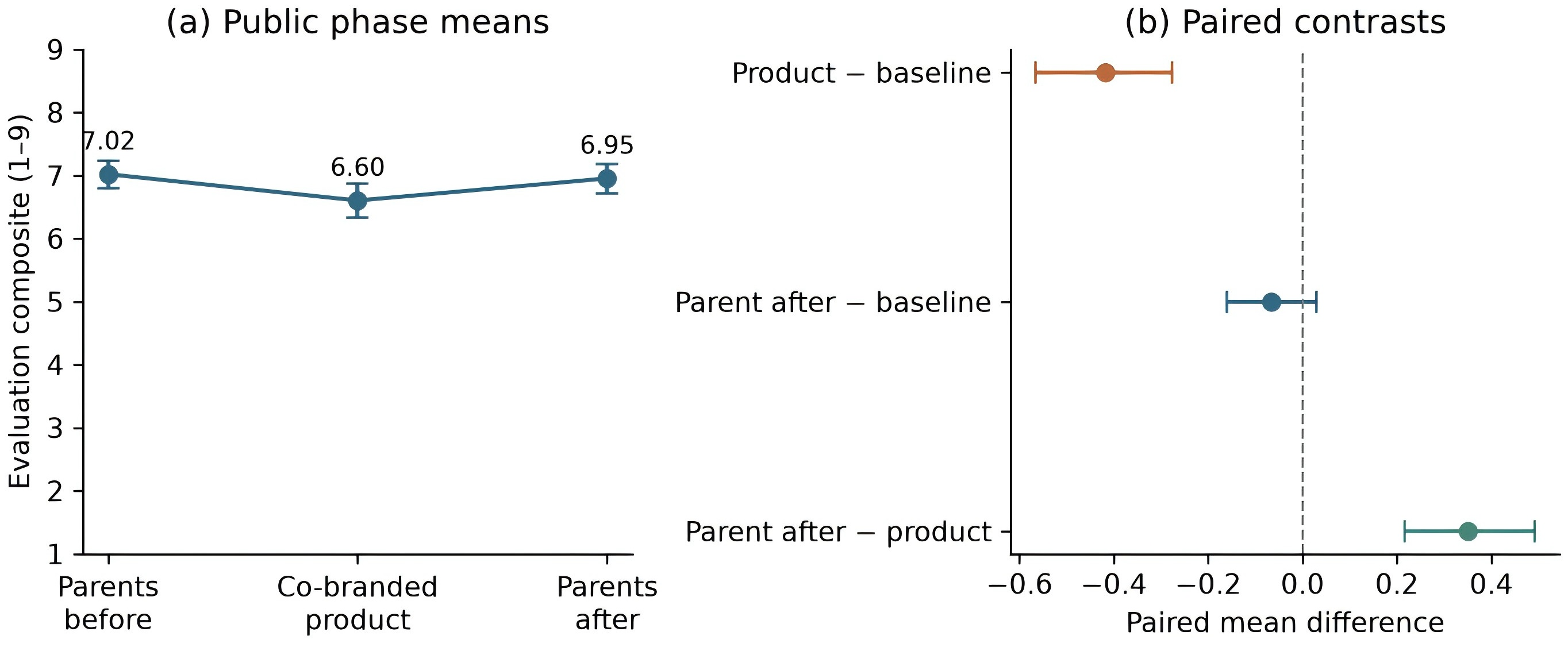
This paper separates co-branded product evaluation from parent-brand evaluation and develops a planning protocol for character intellectual property (IP) research. In 195 public observations, the co-branded product mean was 0.418 points below the pre-exposure parent-brand mean on a nine-point composite (paired-bootstrap 95% CI −0.565 to −0.277). This cross-object comparison is not a decline in the parent brand. The separate within-parent evaluation change was −0.067 (−0.160 to 0.029). We propose persona-conditioned free-text generation and semantic similarity rating (SSR) to explore character-IP equity distributions and inform a future factorial experiment. Generic power simulations are retained separately as sensitivity analyses; no LLM generation or SSR embedding analysis was conducted. The contribution is an explicit distinction between measured evaluation, proposed character-IP equity and simulation-based planning.
References
[1]Keller, K. L. (1993). Conceptualizing, measuring, and managing customer-based brand equity. Journal of Marketing, 57(1), 1–22. https://doi.org/10.1177/002224299305700101
[2]Loken, B., & John, D. R. (1993). Diluting brand beliefs: When do brand extensions have a negative impact? Journal of Marketing, 57(3), 71–84. https://doi.org/10.1177/002224299305700305
[3]Paydas Turan, C. (2021). Success drivers of co-branding: A meta-analysis. International Journal of Consumer Studies, 45(4), 911–936. https://doi.org/10.1111/ijcs.12682
[4]Voss, K. E., Mohan, M., Jung, J. H., & Jiménez, F. R. (2025). The effect of brand alliances across dependent variables and research designs: A meta-analysis. Journal of Business Research, 191, Article 115248. https://doi.org/10.1016/j.jbusres.2025.115248
[5]Friestad, M., & Wright, P. (1994). The persuasion knowledge model: How people cope with persuasion attempts. Journal of Consumer Research, 21(1), 1–31. https://doi.org/10.1086/209380
[6]Vaidyanathan, R., & Aggarwal, P. (2022). Asymmetric brand alliances: When joint promotions with strong brands hurt. Journal of Business Research, 141, 213–228. https://doi.org/10.1016/j.jbusres.2021.12.022
[7]Monika, M., & Antonio, F. (2022). How superhero characters shape brand alliances and leverage the local brand: The evidence from Indonesia. Businesses, 2(1), 33–53. https://doi.org/10.3390/businesses2010003
[8]Yoo, B., & Donthu, N. (2001). Developing and validating a multidimensional consumer-based brand equity scale. Journal of Business Research, 52(1), 1–14. https://doi.org/10.1016/S0148-2963(99)00098-3
[9]Garaus, M., Wolfsteiner, E., & Florack, A. (2022). When food co-branding backfires: The overexpectation effect. Foods, 11(14), Article 2136. https://doi.org/10.3390/foods11142136
[10]Garaus, M. (2022). Datasets (Version 2) [Data set]. Mendeley Data. https://doi.org/10.17632/t876rkzyf4.2
[11]Maier, B. F., Aslak, U., Fiaschi, L., Rismal, N., Fletcher, K., Luhmann, C. C., Dow, R., Pappas, K., & Wiecki, T. V. (2025). LLMs reproduce human purchase intent via semantic similarity elicitation of Likert ratings (Version 3) [Preprint]. arXiv. https://doi.org/10.48550/arXiv.2510.08338
[12]Morris, T. P., White, I. R., & Crowther, M. J. (2019). Using simulation studies to evaluate statistical methods. Statistics in Medicine, 38(11), 2074–2102. https://doi.org/10.1002/sim.8086
[13]Lakens, D. (2022). Sample size justification. Collabra: Psychology, 8(1), Article 33267. https://doi.org/10.1525/collabra.33267
[14]Bacchiega, E., Colucci, M., Denicolò, V., & Magnani, M. (2024). Only the ugly face? A theoretical model of brand dilution. Management Science, 70(5), 3182–3199. https://doi.org/10.1287/mnsc.2022.00852
Downloads
Published
Issue
Section
License
Copyright (c) 2027 Wanting Zhao

This work is licensed under a Creative Commons Attribution 4.0 International License.