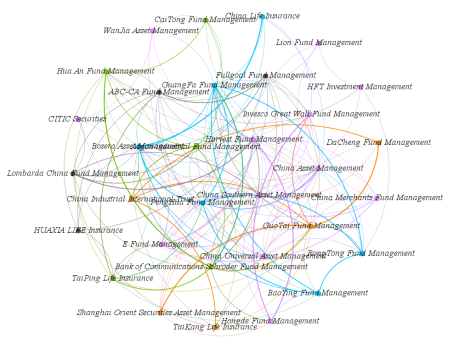
Stock Market Liberalization and Institutional Investor Clique Behavior: Evidence from China
Keywords:
stock market liberalization, domestic institutional investors, clique behavior, hotspot clustering, value clusteringAbstract
This study examines how stock market liberalization affects the clique behavior of domestic institutional investors, distinguishing hotspot clustering from value clustering. Using panel data on Chinese listed firms from 2011 to 2019 and a difference-in-differences design, we identify institutional cliques with the Louvain community detection algorithm, and we apply large language models to cross-validate clique measurement and to construct a cross-border thematic similarity index. We find that stock market liberalization significantly reduces hotspot clustering while promoting value clustering. The inhibitory effect on hotspot clustering is more pronounced for speculative stocks, whereas the promotion of value clustering is stronger among industry leaders. These effects operate through improved market efficiency, optimized institutional holding structures, and enhanced cross-border narrative alignment. Institutions that prioritize fundamental analysis achieve superior investment returns. This study advances research on institutional cliques by integrating large language models into clique measurement and identifies a channel through which foreign investors mitigate short-term speculation in emerging liberalizing markets.
References
Gupta, N., & Yuan, K. (2009). On the growth effect of stock market liberalizations. The Review of Financial Studies, 22(11), 4715-4752.
Mitton, T. (2006). Stock market liberalization and operating performance at the firm level. Journal of Financial Economics, 81(3), 625-647.
Chen, Y., Huang, J., Li, X., & Yuan, Q. (2022). Does stock market liberalization improve stock price efficiency? Evidence from China. Journal of Business Finance and Accounting, 49(7-8), 1175-1210.
Yoon, A. S. (2021). The role of private disclosures in markets with weak institutions: Evidence from market liberalization in China. The Accounting Review, 96(4), 433-455.
Zhang, L., Li, Z., Liao, Y., Wang, Y., & Hu, N. (2023). Foreign investment and information quality: A quasi-experiment from China. International Review of Financial Analysis, 90, 102796.
Chan, M. K., & Kwok, S. (2017). Risk-sharing, market imperfections, asset prices: Evidence from China's stock market liberalization. Journal of Banking and Finance, 84, 166-187.
Huang, J., Chen, Y., Dai, X., & Ni, X. (2022). Stock market liberalization and corporate cash holdings: Evidence from China. Accounting and Finance, 62, 1925-1955.
Moshirian, F., Tian, X., Zhang, B., & Zhang, W. (2021). Stock market liberalization and innovation. Journal of Financial Economics, 139(3), 985-1014.
Meng, Y., Xiong, L., Xiao, L., & Bai, M. (2023). The effect of overseas investors on local market efficiency: Evidence from the Shanghai/Shenzhen–Hong Kong Stock Connect. Financial Innovation, 9(1), 1-32.
Choi, N., & Skiba, H. (2015). Institutional herding in international markets. Journal of Banking and Finance, 55, 246-259.
Tan, L., Chiang, T. C., Mason, J. R., & Nelling, E. (2008). Herding behavior in Chinese stock markets: An examination of A and B shares. Pacific-Basin Finance Journal, 16(1-2), 61-77.
Edmans, A., & Holderness, C. G. (2017). Blockholders: A survey of theory and evidence. The Handbook of the Economics of Corporate Governance, 1, 541-636.
McCahery, J. A., Sautner, Z., & Starks, L. T. (2016). Behind the scenes: The corporate governance preferences of institutional investors. The Journal of Finance, 71(6), 2905-2932.
Chen, X., Li, Q., Cui, W., & Hu, Y. (2023). Institutional investor network embedding and firms' total factor productivity. Emerging Markets Finance and Trade, 59(6), 1896-1918.
Rossi, A. G., Blake, D., Timmermann, A., Tonks, I., & Wermers, R. (2018). Network centrality and delegated investment performance. Journal of Financial Economics, 128(1), 183-206.
Li, J., Zhou, Z. Q., Zhang, Y., & Xiong, X. (2023). Information interaction among institutional investors and stock price crash risk based on multiplex networks. International Review of Financial Analysis, 89, 102780.
Park, J., Sani, J., Shroff, N., & White, H. (2019). Disclosure incentives when competing firms have common ownership. Journal of Accounting and Economics, 67(2-3), 387-415.
Baik, B., Kang, J. K., & Kim, J. M. (2010). Local institutional investors, information asymmetries, and equity returns. Journal of Financial Economics, 97(1), 81-106.
Shue, K. (2013). Executive networks and firm policies: Evidence from the random assignment of MBA peers. The Review of Financial Studies, 26(6), 1401-1442.
Faleye, O., Kovacs, T., & Venkateswaran, A. (2014). Do better-connected CEOs innovate more? Journal of Financial and Quantitative Analysis, 49(5-6), 1201-1225.
Granovetter, M. (1985). Economic action and social structure: The problem of embeddedness. American Journal of Sociology, 91(3), 481-510.
David, P., Duru, A., Lobo, G. J., Maharjan, J., & Zhao, Y. (2022). Threat of exit by non-blockholders and income smoothing: Evidence from foreign institutional investors in Japan. Contemporary Accounting Research, 39(2), 1358-1388.
Yang, B., Guo, C., & Fan, Y. (2024). Institutional investor networks and ESG performance: Evidence from China. Emerging Markets Finance and Trade, 60(1), 113-137.
Pan, N., Xu, Q., & Zhu, H. (2021). The impact of investor structure on stock price crash sensitivity: Evidence from China's stock market. Journal of Management Science and Engineering, 6(3), 312-323.
Barber, B. M., & Odean, T. (2008). All that glitters: The effect of attention and news on the buying behavior of individual and institutional investors. The Review of Financial Studies, 21(2), 785-818.
Li, W., Rhee, G., & Wang, S. S. (2017). Differences in herding: Individual vs. institutional investors. Pacific-Basin Finance Journal, 45, 174-185.
Mei, J., Scheinkman, J. A., & Xiong, W. (2005). Speculative trading and stock prices: Evidence from Chinese AB share premia. Annals of Economics and Finance, 10(2), 225-255.
Abreu, D., & Brunnermeier, M. K. (2002). Synchronization risk and delayed arbitrage. Journal of Financial Economics, 66(2-3), 341-360.
Abreu, D., & Brunnermeier, M. K. (2003). Bubbles and crashes. Econometrica, 71(1), 173-204.
Jang, J., & Kang, J. (2019). Probability of price crashes, rational speculative bubbles, and the cross-section of stock returns. Journal of Financial Economics, 132(1), 222-247.
Marcoux, M., & Lusseau, D. (2013). Network modularity promotes cooperation. Journal of Theoretical Biology, 324, 103-108.
Liao, C., Tang, G., & Xu, X. (2021). Smart money or chasing stars: Evidence from northbound trading in China. International Journal of Finance and Economics, 29(2), 1781-1803.
Gu, M., Kang, W., & Xu, B. (2018). Limits of arbitrage and idiosyncratic volatility: Evidence from China stock market. Journal of Banking and Finance, 86, 240-258.
Ng, L., & Wu, F. (2007). The trading behavior of institutions and individuals in Chinese equity markets. Journal of Banking and Finance, 31(9), 2695-2710.
Schuppli, M., & Bohl, M. T. (2010). Do foreign institutional investors destabilize China's A-share markets? Journal of International Financial Markets, Institutions and Money, 20(1), 36-50.
Edelen, R. M., Ince, O. S., & Kadlec, G. B. (2016). Institutional investors and stock return anomalies. Journal of Financial Economics, 119(3), 472-488.
Ramalingegowda, S., Utke, S., & Yu, Y. (2021). Common institutional ownership and earnings management. Contemporary Accounting Research, 38(1), 208-241.
Scharfstein, D. S., & Stein, J. C. (1990). Herd behavior and investment. The American Economic Review, 80(1), 465-479.
Alldredge, D. M. (2020). Institutional trading, investor sentiment, and lottery-like stock preferences. Financial Review, 55(4), 603-624.
Xiong, L., Deng, H., & Xiao, L. (2021). Does stock market liberalization mitigate litigation risk? Evidence from Stock Connect in China. Economic Modelling, 102, 105581.
Li, K. (2020). Does information asymmetry impede market efficiency? Evidence from analyst coverage. Journal of Banking and Finance, 118, 105856.
Aggarwal, R., Erel, I., Ferreira, M., & Matos, P. (2011). Does governance travel around the world? Evidence from institutional investors. Journal of Financial Economics, 100(1), 154-181.
Huo, R., & Ahmed, A. D. (2017). Return and volatility spillovers effects: Evaluating the impact of Shanghai-Hong Kong Stock Connect. Economic Modelling, 61, 260-272.
Chen, Z., Du, J., Li, D., & Ouyang, R. (2013). Does foreign institutional ownership increase return volatility? Evidence from China. Journal of Banking and Finance, 37(2), 660-669.
Chuang, Y.-W., Lin, Y.-F., & Weng, P.-S. (2019). Why and how do foreign institutional investors outperform domestic investors in futures trading: Evidence from Taiwan. Journal of Futures Markets, 39(3), 279-301.
Bajo, E., Chemmanur, T. J., Simonyan, K., & Tehranian, H. (2016). Underwriter networks, investor attention, and initial public offerings. Journal of Financial Economics, 122(2), 376-408.
Crane, A. D., Koch, A., & Michenaud, S. (2019). Institutional investor cliques and governance. Journal of Financial Economics, 133(1), 175-197.
Blondel, V. D., Guillaume, J.-L., Lambiotte, R., & Lefebvre, E. (2008). Fast unfolding of communities in large networks. Journal of Statistical Mechanics: Theory and Experiment, 2008(10), P10008.
Tetlock, P. C. (2007). Giving content to investor sentiment: The role of media in the stock market. The Journal of Finance, 62(3), 1139-1168.
Mavruk, T. (2021). Cross-regional differences in news tone and local stock ownership. Management Science, 67(5), 3276-3298.
Gao, K., Pittman, J., Wang, X., & Wang, Z. T. (2023). Stock market liberalization and earnings management: Evidence from a quasi-natural experiment in China. Contemporary Accounting Research, 40(4), 2547-2576.
Pfeffer, J., & Salancik, G. R. (2003). The external control of organizations: A resource dependence perspective. Stanford University Press.
Chen, Y., Han, H., Shen, X., & Zeng, J. (2023). The effect of stock market liberalization on corporate cash savings sensitivity: Evidence from China. International Review of Economics and Finance, 88, 1247-1271.
Dass, N., Massa, M., & Patgiri, R. (2008). Mutual funds and bubbles: The surprising role of contractual incentives. The Review of Financial Studies, 21(1), 51-99.
Bali, T. G., Cakici, N., & Whitelaw, R. F. (2011). Maxing out: Stocks as lotteries and the cross-section of expected returns. Journal of Financial Economics, 99(2), 427-446.
Liu, B., Wang, H., Yu, J., & Zhao, S. (2020). Time-varying demand for lottery: Speculation ahead of earnings announcements. Journal of Financial Economics, 138(3), 789-817.
Zwiebel, J. (1995). Block investment and partial benefits of corporate control. The Review of Economic Studies, 62(2), 161-185.
Cai, C. X., Hillier, D., & Wang, J. (2016). The cost of multiple large shareholders. Financial Management, 45(2), 401-430.
Attig, N., El Ghoul, S., & Guedhami, O. (2009). Do multiple large shareholders play a corporate governance role? Evidence from East Asia. Journal of Financial Research, 32(4), 395-422.
Amihud, Y. (2002). Illiquidity and stock returns: Cross-section and time-series effects. Journal of Financial Markets, 5(1), 31-56.
Morck, R., Yeung, B., & Yu, W. (2000). The information content of stock markets: Why do emerging markets have synchronous stock price movements? Journal of Financial Economics, 58(1-2), 215-260.
Cremers, M., Pareek, A., & Sautner, Z. (2020). Short-term investors, long-term investments, and firm value: Evidence from Russell 2000 index inclusions. Management Science, 66(10), 4535-4551.