Artificial Intelligence in Branding: The Influence of AI-Quality on Brand Perception and Consumer Loyalty
Keywords:
Artificial Intelligence, AI-Quality, Brand Perception, Brand Loyalty, Consumer Behavior, Structural Equation ModAbstract
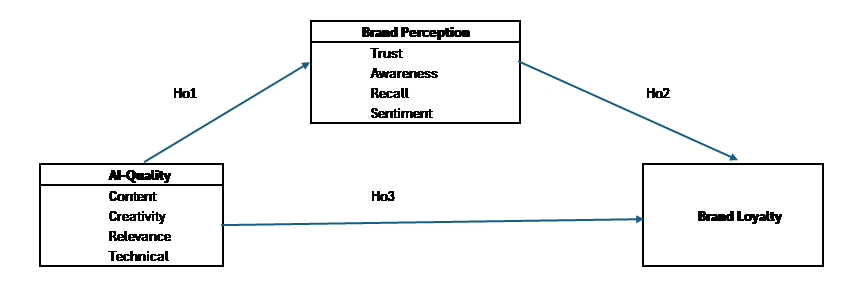
This study investigates the relationship between artificial intelligence (AI) quality, brand perception, and brand loyalty, with a focus on how consumers assess AI-generated content within branding contexts. AI quality was conceptualized across four dimensions: creativity, relevance, technical and content —and tested for its influence on brand perception (trust, awareness, recall, and sentiment) and, ultimately, on brand loyalty. A quantitative design was employing a structured survey of 110 consumers in the Philippines who were knowledgeable about AI-assisted brand communication. Data analysis included descriptive statistics, validity and reliability tests, multiple regression, and structural equation modeling (SEM) to evaluate direct and mediated relationships. Results suggest that AI quality significantly predicts brand loyalty, with technical performance and creativity being the most influential factors. Conversely, content and relevance have weaker direct effects, indicating that these aspects alone may not ensure long-term loyalty. SEM analysis further corroborates that brand perception acts as a mediator in the relationship between AI quality and loyalty, particularly through trust, recall, and sentiment. This study contributes to AI marketing research by validating the mediating role of brand perception and offers practical insights for Philippine businesses to prioritize robust and creative AI outputs while cultivating consumer trust.
References
Do, Q., & Geyer, R(2025). Hide or highlight: Understanding the impact of factuality expression on user trust. arXiv preprint :2508.07095. https://arxiv.org/abs/2508.07095
Huschens, M., Herrmann, J., Wobker, I., & Aydin, A. (2023).Do you trust ChatGPT? – Perceived credibility of human and AI-generated content. arXiv preprint :2309.02524. https://arxiv.org/abs/2309.02524
Hattori, E. A., Yamakawa, M., & Miwa, K. (2024). Human bias in evaluating AI product creativity. Journal of Creativity, 34(2). https://doi.org/10.1016/j.yjoc.2024.100087
Chaudhuri, A., & Holbrook, M. B. (2001). The chain of effects from brand trust and brand affect to brand performance: The role of brand loyalty. Journal of Marketing, 65(2), 81–93. https://doi.org/10.1509/jmkg.65.2.81.18255
Delgado-Ballester, E. (2004). Applicability of a brand trust scale across product categories: A multigroup invariance analysis. European Journal of Marketing, 38(5/6), 573–592. https://doi.org/10.1108/03090560410529222
Keller, K. L. (1993). Conceptualizing, measuring, and managing customer-based brand equity. Journal of Marketing, 57(1), 1–22. https://doi.org/10.1177/002224299305700101
Keller, K. L. (2009). Building strong brands in a modern marketing communications environment. Journal of Marketing Communications, 15(2–3), 139–155. https://doi.org/10.1080/13527260902757530
Netemeyer, R. G., Krishnan, B., Pullig, C., Wang, G., Yagci, M., Dean, D., Ricks, J., & Wirth, F. (2004). Developing and validating measures of facets of customer-based brand equity. Journal of Business Research, 57(2), 209–224. https://doi.org/10.1016/S0148-2963(01)00303-4
Thomson, M., MacInnis, D. J., & Park, C. W. (2005). The ties that bind: Measuring the strength of consumers’ emotional attachments to brands. Journal of Consumer Psychology, 15(1), 77–91. https://doi.org/10.1207/s15327663jcp1501_10
Laroche, M., Habibi, M. R., Richard, M. O., & Sankaranarayanan, R. (2012). The effects of social media–based brand communities on brand community markers, value creation practices, brand trust, and brand loyalty. Computers in Human Behavior, 28(5), 1755–1767. https://doi.org/10.1016/j.chb.2012.04.016
Grewal, D., Hulland, J., Kopalle, P. K., & Karahanna, E. (2020). The future of technology and marketing: A multidisciplinary perspective. Journal of the Academy of Marketing Science, 48(1), 1–8. https://doi.org/10.1007/s11747-019-00711-4
Fournier, S. (1998). Consumers and their brands: Developing relationship theory in consumer research. Journal of Consumer Research, 24(4), 343–373. https://doi.org/10.1086/209515
Iglesias, O., Markovic, S., & Rialp, J. (2019). How does sensory brand experience influence brand equity? Considering the roles of customer-based brand equity dimensions. Journal of Business Research, 96, 343–354.https://doi.org/10.1016/j.jbusres.2018.05.043
Longoni, C., Bonezzi, A., & Morewedge, C. K. (2019). Resistance to Medical Artificial Intelligence. Journal of Consumer Research, 46(4), 629–650. https://doi.org/10.1093/jcr/ucz013
Kapferer, J.-N. (2012). The new strategic brand management: Advanced insights and strategic thinking (5th ed.). Kogan Page Publishers.
Huang, M.-H., & Rust, R. T. (2021). Engaged to a Robot? The Role of AI in Service. Journal of Service Research, 24(1), 3–28. https://doi.org/10.1177/1094670520902266
Rahman, M., Sultan, M. T., & Hossain, M. S. (2023). Artificial intelligence in marketing: Consumer trust, satisfaction, and loyalty. Journal of Retailing and Consumer Services, 72, 103201.
Gursoy, D., Chi, O. H., Lu, L., & Nunkoo, R. (2019). Consumers acceptance of artificially intelligent (AI) device use in service delivery. International Journal of Information Management, 49, 157–169. https://doi.org/10.1016/j.ijinfomgt.2019.03.008
Dwivedi, Y. K., Hughes, L., Baabdullah, A. M., Ribeiro-Navarrete, S., Giannakis, M., Al-Debei, M. M., & Wamba, S. F. (2022). Metaverse beyond the hype: Multidisciplinary perspectives on emerging challenges, opportunities, and agenda for research, practice and policy. International Journal of Information Management, 66, 102542. https://doi.org/10.1016/j.ijinfomgt.2022.102542