Automated Assessment of Sentence Stress Placement in L2 Chinese Using Deep Learning: An Empirical and Pedagogical Study
Keywords:
Deep Learning, Automated Assessment, Sentence Stress, Second Language Acquisition, Chinese ProsodyAbstract
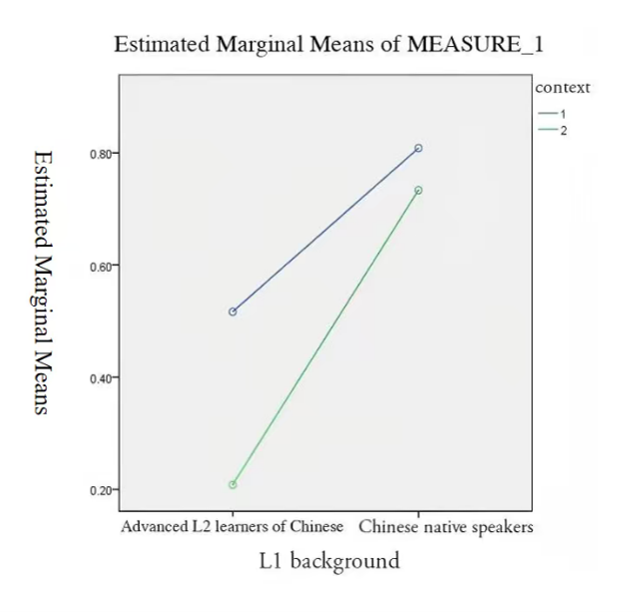
This study investigated English-speaking learners' acquisition of Chinese sentence stress in ambiguous contexts using a deep learning-based automated assessment approach. A fine-tuned wav2vec 2.0 model achieved 91.2% agreement with human raters (Cohen's κ = 0.85). Experiment 1 compared learners' and native speakers' stress identification across semantic contexts. Automated acoustic analysis revealed that learners' accuracy was significantly lower in secondary than primary meaning contexts (p < 0.1), while native speakers showed no difference. Experiment 2 compared stress location instruction with general training methods. Automated assessment found no significant difference between the two methods (p > 0.5). These findings indicate that learners lack proficiency in semantic-driven stress placement, particularly in secondary meanings, and that instruction focusing solely on stress location is insufficient. Methodologically, this study demonstrates the feasibility of deep learning-based automated prosody assessment. Pedagogically, it recommends integrating prosodic features (pitch, duration) into Chinese language teaching and supports AI-driven Computer-Assisted Pronunciation Training (CAPT) systems.
References
Baevski, A., Zhou, Y., Mohamed, A., & Auli, M. (2020). wav2vec 2.0: A framework for self-supervised learning of speech representations. Advances in Neural Information Processing Systems, 33, 12449–12460.
Cao Wen. (2010). 汉语焦点重音的韵律实现 [The prosodic realization of focus stress in Chinese]. Beijing: Beijing Language and Culture University Press. [in Chinese]
Chen Yongming, & Cui Yao. (1997). 汉语歧义句的加工 [The processing of ambiguous sentences in Chinese]. Acta Psychologica Sinica, (1). [in Chinese]
Chen, Y., & Gussenhoven, C. (2008). Emphasis and tonal implementation in Standard Chinese. Journal of Phonetics, 36(4), 724–746.
Cheng Shuqiu. (2005). 句重音在对外汉语语法教学中的作用 [The role of sentence stress in teaching Chinese grammar as a foreign language]. Continuing Education Research, (4), 126–128. [in Chinese]
Ellis, N. C. (2002). Reflections on frequency effects in language processing. Studies in Second Language Acquisition, 24(2), 297–339.
Ellis, R. (1994). The study of second language acquisition. Oxford: Oxford University Press.
Feng Shengli. (2009). 汉语的韵律、词法与句法:修订本 [Prosody, morphology, and syntax in Chinese: Revised edition]. Beijing: Peking University Press. [in Chinese]
Flege, J. E., & Eefting, W. (1987). Production and perception of English stops by native Spanish speakers. Journal of Phonetics, 15, 67–83.
Gao, J., & Gu, Y. (2024). Same sentences, different meanings: Prosodic and gestural resolution of ambiguity in Mandarin Chinese. In Proceedings of Speech Prosody 2024 (pp. 886–890). International Speech Communication Association.
Ji Xiuqing. (1998). 语句重音与口语教学 [Sentence stress and oral Chinese teaching]. In 对外汉语语音与语音教学研究 [Studies on Chinese phonetics and phonetics teaching as a foreign language] (pp. 357–368). Beijing: Sinolingua Press. [in Chinese]
Lu Jianji. (1984). 中介语理论与外国人学习汉语的语音偏误分析 [Interlanguage theory and an analysis of phonetic errors in foreigners’ learning of Chinese]. Language Teaching and Linguistic Studies, (3). [in Chinese]
MacWhinney, B. (2006). Emergentism: Use often and with care. Applied Linguistics, 27(4), 729–740.
Qiu Shanshan. (2007). 日本留学生汉语陈述句核心重音的韵律表现 [The prosodic realization of core stress in Mandarin declarative sentences by Japanese international students]. Master's thesis, Beijing Language and Culture University. [in Chinese]
Wang Yunjia. (2002). 汉语语音研究与汉语语音教学接口的问题 [Issues at the interface between Chinese phonetic research and Chinese pronunciation teaching]. In 对外汉语论丛(第二辑) [Essays on teaching Chinese as a foreign language, Vol. 2]. Shanghai: Shanghai Foreign Language Education Press. [in Chinese]
Wang Yunjia, Chu Min, & He Lin. (2006). 汉语焦点重音和语义重音分布的初步试验研究 [A preliminary experimental study of the distribution of focus stress and semantic stress in Chinese]. Chinese Teaching in the World, (2). [in Chinese]
Witt, S. M., & Young, S. J. (2000). Phone-level pronunciation scoring and assessment for interactive language learning. Speech Communication, 30(2–3), 95–108.
Xu, Y. (1999). Effects of tone and focus on the formation and alignment of F0 contours. Journal of Phonetics, 27(1), 55–105.
Yang Defeng. (1991). 重音与语义:句子重音 [Stress and semantics: Sentence stress]. In 第三届国际汉语教学讨论会论文选 [Selected papers from the Third International Conference on Chinese Language Teaching]. Beijing: Peking University Press. [in Chinese]
Zhang Juan. (2009). 美国留学生汉语陈述句核心重音的韵律表现研究 [A study on the prosodic realization of core stress in Mandarin declarative sentences by American international students]. Master's thesis, Beijing Language and Culture University. [in Chinese]
Zhu Chuan. (Ed.). (1997). 汉语语音学习对策 [Strategies for learning Chinese phonetics]. Beijing: Yuwen Press. [in Chinese]