Research on the Double-Edged Sword Effects of Artificial Intelligence on Enterprise Human Resource Management
Keywords:
Artificial Intelligence, Human Resource Management, Double‐edged Sword Effects, Algorithmic Management, Ethical AI; Human-AI CollaborationAbstract
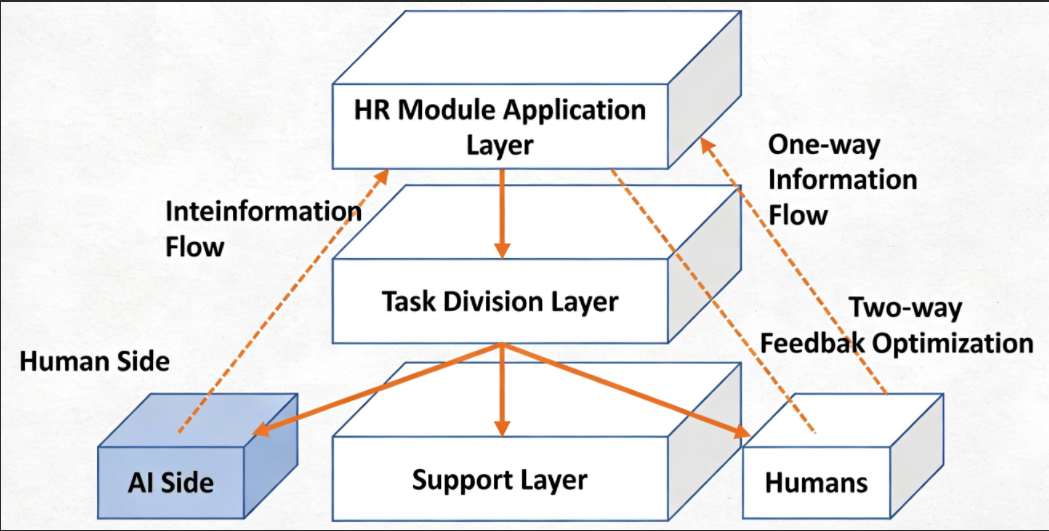
Artificial intelligence has been increasingly embedded into the full‐cycle practices of enterprise human resource management (HRM), forming a typical technological empowerment scenario with coexisting opportunities and predicaments. Based on the Technology Acceptance Model, Sociotechnical Systems Theory, and Organizational Justice Theory, this paper constructs an integrated theoretical framework to systematically dissect the double‐edged sword effects of AI application in HRM. The positive dimensions are refined into four core paths: efficiency improvement in recruitment and selection, objectivity enhancement in performance management, personalized empowerment of employee development, and data‐driven upgrading of strategic decision‐making. The negative dimensions are summarized as four prominent risks: algorithmic bias and discriminatory infringement, employee privacy leakage and supervision anxiety, dehumanization of employment relations, and multi‐level organizational resistance. Furthermore, this study explores the differential impact mechanisms of AI outcomes from four dimensions: AI system design, implementation procedures, organizational contextual factors, and individual employee differences. On this basis, targeted coping strategies are proposed from ethical design, transparent governance, employee participation, and human‐AI hybrid collaboration, aiming to provide theoretical references and practical paths for enterprises to maximize the positive effects of AI and control potential risks in HRM practices.
References
Bostrom, R. P., & Heinen, J. S. (1977). MIS problems and failures: A socio-technical perspective. MIS Quarterly, 1(3), 17-32.
Budhwar, P., Chowdhury, S., Wood, G., Aguinis, H., Bamber, G. J., Beltran, J. R., & Varma, A. (2023). Human resource management in the age of generative artificial intelligence: Perspectives and research directions on ChatGPT. Human Resource Management Journal, 33(3), 606-659.
Colquitt, J. A. (2001). On the dimensionality of organizational justice: A construct validation of a measure. Journal of Applied Psychology, 86(3), 386-400.
Davis, F. D. (1989). Perceived usefulness, perceived ease of use, and user acceptance of information technology. MIS Quarterly, 13(3), 319-340.
Fernández-Vidal, J., Peral-Peral, B., & Gascó, J. L. (2025). Technology-driven change in human resource management: Reshaping talent management and organizational design. Administrative Sciences, 15(11), 452.
Malyshev, V., Lipskyi, Y., Kovalenko, V., Gab, A., Shakhnin, D., & Orel, O. (2024). Assessment of the global artificial intelligence market in healthcare. Technology audit and production reserves, 6(4/80), 62-70.
Greenberg, J. (1987). A taxonomy of organizational justice theories. Academy of Management Review, 12(1), 9-22.
Ioniță, A., & Ștefan, S. C. (2025). Strategic human resource management in the digital era: Technology, transformation, and sustainable advantage. Merits, 5(4), 23.
Kellogg, K. C., Valentine, M. A., & Christin, A. (2020). Algorithms at work: The new contested terrain of control. Academy of Management Annals, 14(1), 366-410.
Kim, S., Khoreva, V., & Vaiman, V. (2025). Strategic human resource management in the era of algorithmic technologies: Key insights and future research agenda. Human Resource Management, 64(2), 447-464.
Marliyas, A., Ummah, M. A. C. S., & Gunapalan, S. (2026). The transformation of talent acquisition through artificial intelligence in the context of Industry 4.0: A systematic literature review. Journal of Business Research and Innovation, 11(2).
Trist, E. L., & Bamforth, K. W. (1951). Some social and psychological consequences of the longwall method of coal-getting. Human Relations, 4(1), 3-38.
Vaishnavi, D., Hada, V., Sharma, R., Singh, G., Singh, R. K., & Bhingardive, S. (2026). Integrating AI into human resource management: Implications for recruitment and retention. Journal of Asia Entrepreneurship and Sustainability, 22(1).
Venkatesh, V., Morris, M. G., Davis, G. B., & Davis, F. D. (2003). User acceptance of information technology: Toward a unified view. MIS Quarterly, 27(3), 425-478.