Research on the Impact of Artificial Intelligence on Human Resource Management in Listed Enterprises and Countermeasures
Keywords:
Artificial Intelligence, Human Resource Management, Listed Enterprises, Algorithmic Management, Digital TransformationAbstract
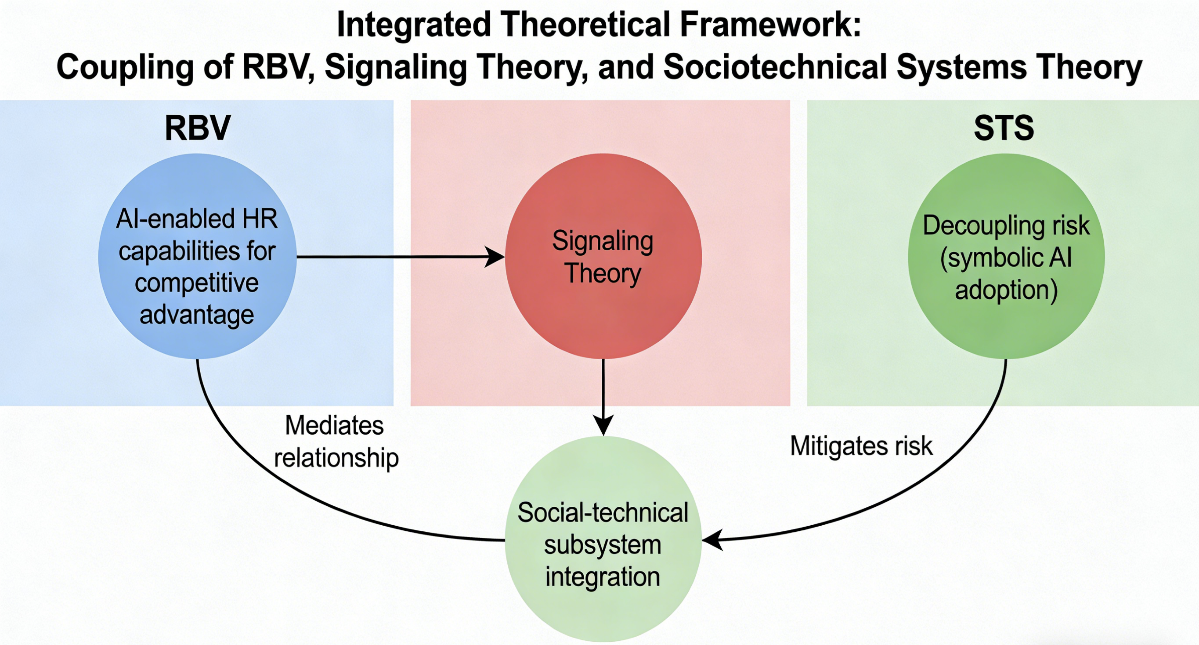
The integration of artificial intelligence into human resource management has accelerated significantly, particularly within listed enterprises that face unique pressures from investors, regulators, and public scrutiny. Drawing upon the resource-based view, signaling theory, and sociotechnical systems theory, this study develops a comprehensive theoretical framework to examine the multifaceted impact of AI on HRM in listed enterprises. The analysis identifies three primary impact pathways: algorithmic decision-making in recruitment and selection, predictive analytics in performance management and retention, and automation in HR service delivery. The study further explores organizational implications, including structural changes within HR functions, evolving workforce skill requirements, and transformations in employee-employer relationships. In response to these challenges, countermeasures are proposed across four domains: strategic alignment of AI with HR objectives, ethical governance frameworks, workforce reskilling initiatives, and hybrid human-AI work design. The framework provides theoretical contributions to the AI-HRM literature and offers practical guidance for executives, HR leaders, and boards in listed enterprises seeking to leverage AI for competitive advantage while managing associated risks.
References
Barney, J. (1991). Firm resources and sustained competitive advantage. Journal of Management, 17(1), 99–120.
Budhwar, P., Chowdhury, S., Wood, G., Aguinis, H., Bamber, G. J., Beltran, J. R., … & Varma, A. (2023). Human resource management in the age of generative artificial intelligence: Perspectives and research directions on ChatGPT. Human Resource Management Journal, 33(3), 606–659.
Budhwar, P., Malik, A., De Silva, M. T., & Thevisuthan, P. (2022). Artificial intelligence in human resource management: A review and research agenda. Journal of Business Research, 143, 297–309.
Campbell, B. A., Coff, R., & Kryscynski, D. (2012). Rethinking sustained competitive advantage from human capital. Academy of Management Review, 37(3), 376–395.
Cheng, M. M., & Hackett, R. D. (2021). A critical review of algorithms in HRM: Definition, theory, and practice. Human Resource Management Review, 31(1), Article 100698.
Chowdhury, S., Dey, P., Joel-Edgar, S., Bhattacharya, S., Rodriguez-Espindola, O., Abadie, A., & Truong, L. (2023). Unlocking the value of artificial intelligence in human resource management through AI capability framework. Human Resource Management Review, 33(1), Article 100899.
Connelly, B. L., Certo, S. T., Ireland, R. D., & Reutzel, C. R. (2011). Signaling theory: A review and assessment. Journal of Management, 37(1), 39–67.
Dietvorst, B. J., Simmons, J. P., & Massey, C. (2018). Overcoming algorithm aversion: People will use imperfect algorithms if they can (even slightly) modify them. Management Science, 64(3), 1155–1170.
Ioniță, A., & Ștefan, S. C. (2025). Strategic human resource management in the digital era: Technology, transformation, and sustainable advantage. Merits, 5(4), Article 23.
Jarrahi, M. H. (2018). Artificial intelligence and the future of work: Human-AI symbiosis in organizational decision making. Business Horizons, 61(4), 577–586.
Kellogg, K. C., Valentine, M. A., & Christin, A. (2020). Algorithms at work: The new contested terrain of control. Academy of Management Annals, 14(1), 366–410.
Kim, S., Khoreva, V., & Vaiman, V. (2025). Strategic human resource management in the era of algorithmic technologies: Key insights and future research agenda. Human Resource Management, 64(2), 447–464.
Langer, M., König, C. J., & Papathanasiou, M. (2019). Highly automated job interviews: Acceptance under the influence of stakes. International Journal of Selection and Assessment, 27(3), 217–234.
Marliyas, A., Ummah, M. A. C. S., & Gunapalan, S. (2026). The transformation of talent acquisition through artificial intelligence in the context of Industry 4.0: A systematic literature review. Journal of Business Research and Innovation, 11(2).
Meyer, J. W., & Rowan, B. (1977). Institutionalized organizations: Formal structure as myth and ceremony. American Journal of Sociology, 83(2), 340–363.
Spence, M. (1973). Job market signaling. The Quarterly Journal of Economics, 87(3), 355–374.
Trist, E. L., & Bamforth, K. W. (1951). Some social and psychological consequences of the longwall method of coal-getting. Human Relations, 4(1), 3–38.
van Esch, P., & Black, J. S. (2021). Artificial intelligence (AI) in human resource management (HRM): A systematic literature review and future research agenda. The International Journal of Human Resource Management, 32(6), 1245–1278.
Wright, P. M., Dunford, B. B., & Snell, S. A. (2001). Human resources and the resource-based view of the firm. Journal of Management, 27(6), 701–721.
Zhao Shuming, Zhang Min, Zhao Yixuan. (2019). 人力资源管理百年:演变与发展 [A Century of Human Resource Management: Evolution and Development]. Foreign Economics and Management. 41(12), 50–73.[in Chinese]
Zhao Yixuan, Zhao Shuming, Luan Jiarui. (2020). 基于人工智能的人力资源管理:理论模型与研究展望 [Artificial Intelligence-Based Human Resource Management: Theoretical Models and Research Prospects]. Nanjing Social Sciences. (2), 26-33.[in Chinese]Q