A Hybrid TAM–Learning Analytics Framework for Predicting University Students’ Adoption of Educational Technology
Keywords:
Technology Acceptance Model, TAM, Learning Analytics, Educational Technology Adoption, Behavioral Intention, SEM, Random ForestAbstract
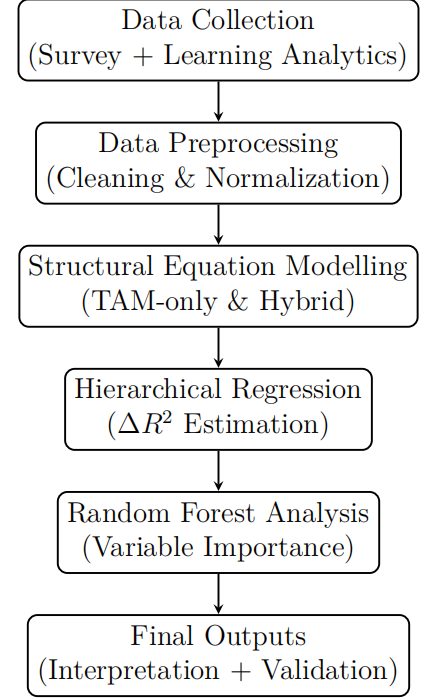
This study develops a hybrid analytical framework integrating the Technology Acceptance Model (TAM) with learning analytics indicators to explain university students’ adoption of educational technology. While TAM emphasizes perceptual constructs such as perceived usefulness (PU) and perceived ease of use (PEOU), modern digital learning systems generate rich behavioral data that may also shape learners’ adoption decisions. Data were collected from 162 undergraduate students using validated measurement scales for PU, PEOU, and behavioral intention (BI), together with self-reported learning analytics indicators including interaction frequency, time-on-task, and digital participation levels. Structural equation modeling was conducted using Python based SEM analysis. Results show that PU and PEOU significantly predict BI, consistent with classical TAM. Incorporating learning analytics indicators improves explanatory power, with hierarchical regression revealing an increase in R2 from 0.689 (TAM-only) to 0.739 in the hybrid model (∆R2 = 0.050). Random Forest analysis further confirms the predictive importance of PU and learning analytics features. These findings demonstrate that behavioral engagement data substantially enhance students’ technology adoption processes. The study contributes theoretically by integrating cognitive and behavioral perspectives of adoption, and offers practical implications for designing more engaging and data-informed digital learning environments.
References
Ahmad, A., Schneider, J., Griffiths, D., Biedermann, D., Schiffner, D., Greller, W., & Drachsler, H. (2024). Connecting the dots–A literature review on learning analytics indicators from a learning design perspective. Journal of Computer Assisted Learning, 40(6), 2432-2470.
Backhaus, K., Erichson, B., & Weiber, R. (2015). Fortgeschrittene multivariate Analysemethoden: eine anwendungsorientierte Einführung. Springer-Verlag.
Badal, Y. T., & Sungkur, R. K. (2023). Predictive modelling and analytics of students’ grades using machine learning algorithms. Education and information technologies, 28(3), 3027-3057.
Breiman, L. (2001). Random forests. Machine learning, 45(1), 5-32.
Feng, J., Yu, B., Tan, W. H., Dai, Z., & Li, Z. (2025). Key factors influencing educational technology adoption in higher education: A systematic review. PLOS Digital Health, 4(4), e0000764.
Granić, A. (2022). Educational technology adoption: A systematic review. Education and Information Technologies, 27(7), 9725-9744.
Granić, A. (2024). Technology adoption at individual level: toward an integrated overview. Universal Access in the Information Society, 23(2), 843-858.
Ifenthaler, D. and Yau, J. Y. K. (2020). Utilising learning analytics to support study success in higher education: a systematic review. Educational Technology Research and Development, 68(4):1961–1990.
Ifenthaler, D., Schumacher, C., & Kuzilek, J. (2023). Investigating students' use of self‐assessments in higher education using learning analytics. Journal of Computer Assisted Learning, 39(1), 255-268.
Jovanovic, J., López-Pernas, S., & Saqr, M. (2024). Predictive modelling in learning analytics: A machine learning approach in R. In Learning Analytics Methods and Tutorials: A Practical Guide Using R (pp. 197-229). Cham: Springer Nature Switzerland.
Kaushik, M. K., & Verma, D. (2020). Determinants of digital learning acceptance behavior: A systematic review of applied theories and implications for higher education. Journal of Applied Research in Higher Education, 12(4), 659-672.
Lang, C., Wise, A. F., Merceron, A., Gašević, D., & Siemens, G. (2022). What is learning analytics. The handbook of learning analytics, 8-18.
Li, H., Zhu, S., Wu, D., Yang, H. H., & Guo, Q. (2023). Impact of information literacy, self-directed learning skills, and academic emotions on high school students’ online learning engagement: A structural equation modeling analysis. Education and information technologies, 28(10), 13485-13504.
Liu, C., Wang, Y., Evans, M., & Correia, A. P. (2024). Critical antecedents of mobile learning acceptance and moderation effects: A meta-analysis on technology acceptance model. Education and Information Technologies, 29(15), 20351-20382.
Littlejohn, A. (2021). Professional learning analytics. Society for Learning Analytics and Research.
Nazaretsky, T., Ariely, M., Cukurova, M., & Alexandron, G. (2022). Teachers' trust in AI‐powered educational technology and a professional development program to improve it. British journal of educational technology, 53(4), 914-931.