Bio-Inspired Adaptive Dynamic Attention: An Empirically Driven AI Framework for Human–Machine Coaching in Team Collaborative Decision-Making
Keywords:
Cognitive-load-aware Attention, LSTM Gating, Physiological Workload Estimation, Democratic Coaching Systems, Edge DeploymentAbstract
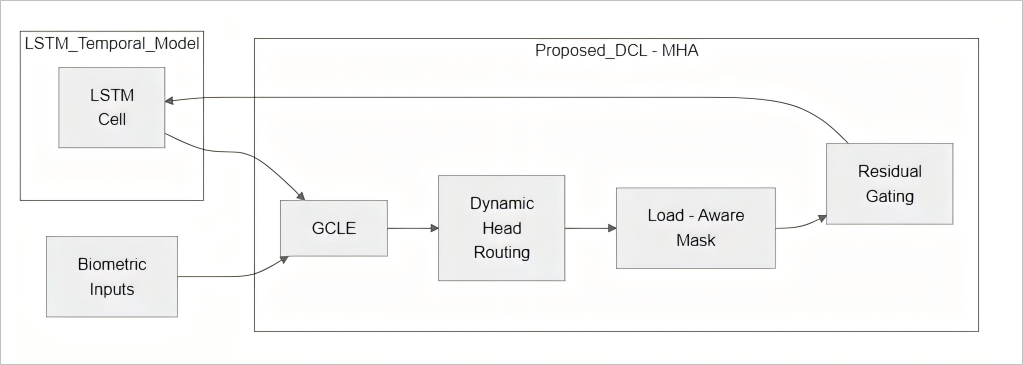
This paper introduces the Dynamic Cognitive Load-LSTM Attention Routing (DCLAR) framework for real-time AI-driven coaching. We combine real-time indicators of mental workload with an attention-based model to coordinate team collaboration. Moving beyond static multi-head attention models, we present a Gated Cognitive Load Estimator (GCLE) that leverages physiological and behavioral signals—including heart rate variability and speech rate—to infer participants cognitive load in real time.We use the load values to decide which attention heads should stay active in the LSTM at each step, enhancing computational efficiency without compromising critical contextual information. A residual gating mechanism is further incorporated to fuse attention outputs with LSTM hidden states, ensuring stable gradient propagation amid cognitive load fluctuations. Implemented on edge devices such as the NVIDIA Jetson Orin, DCLAR operates with sub-millisecond latency. Experimental evaluations demonstrate a reduction of up to 40% in redundant computations compared to static benchmarks, while maintaining comparable performance. By linking findings from cognitive science to model design, we create an AI coach that adapts to users’ mental states.
References
A Vaswani, N Shazeer, N Parmar, et al. (2017) Attention is all you need. In Advances in Neural Information Processing Systems.
J Sweller (2011) Cognitive load theory. Psychology of learning and motivation.
A Graves (2012) Long short-term memory. Supervised Sequence Labelling With Recurrent Neural Networks.
GF Franklin, JD Powell, A Emami-Naeini & JD Powell (2002) Feedback control of dynamic systems. scsolutions.com.
T Heilig & I Scheer (2023) Decision intelligence: Transform your team and organization with AI-Driven decision-making. books.google.com.
W Hua, Y Zhou, CM De Sa, et al. (2019) Channel gating neural networks. In Advances in Neural Information Processing Systems.
M Pandey, R Pandey & A Nazarov (2023) Dynamic Multihead Attention for Enhancing Neural Machine Translation Performance. Unable to Determine Complete Venue.
D Xiao, Q Meng, S Li & X Yuan (2024) Improving transformers with dynamically composable multi-head attention. arXiv preprint arXiv:2405.08553.
Y Xu, Q Pan, Z Wang & B Hu (2024) A Novel Hypersonic Target Trajectory Estimation Method Based on Long Short-Term Memory and a Multi-Head Attention Mechanism. Entropy.
HS Macedo, ITF Santos & ELO da Silva (2023) The power of attention: Bridging cognitive load, multimedia learning, and AI. arXiv preprint arXiv:2311.06586.
V Yoghourdjian, Y Yang, T Dwyer, et al. (2020) Scalability of network visualisation from a cognitive load perspective. IEEE Transactions On Visualization And Computer Graphics.
UA Abdurrahman, SC Yeh, Y Wong & L Wei (2021) Effects of neuro-cognitive load on learning transfer using a virtual reality-based driving system. Big Data and Cognitive Computing.
Y Huang & X Wang (2024) Hazards Prioritization With Cognitive Attention Maps for Supporting Driving Decision-Making. IEEE Transactions on Intelligent Transportation Systems.
S Joshi (2025) The Role of AI in Enhancing Teamwork, Resilience and Decision-Making: Review of Recent Developments. Unable to determine the complete publication venue.
U Javed, A Rohilla, G Adnan & N Taj (2025) Exploring how AI can be used to Promote Collaboration in group Project reduce Conflict in Team Dynamics and Enhance Cooperative Learning Experiences. Unable to determine the complete publication venue.
LNR Mudunuri, M Hullurappa, VR Vemula, et al. (2025) AI-powered leadership: Shaping the future of management. Igi - Global.
S Gurulakshmi & R Gayathri (2025) The human-AI partnership: Elevating leadership with emotional intelligence. Unable to determine the complete publication venue.
R Bao (2025) Maximizing the Potential of Multiheaded Attention Mechanisms Dynamic Head Allocation Algorithm. scitepress.org.
J Janssen & PA Kirschner (2020) Applying collaborative cognitive load theory to computer-supported collaborative learning: Towards a research agenda. Educational Technology Research and Development.
R Gavas, D Chatterjee & A Sinha (2017) Estimation of cognitive load based on the pupil size dilation. In 2017 IEEE International Conference On Advanced Learning Technologies.
J Bóna & M Bakti (2020) The effect of cognitive load on temporal and disfluency patterns of speech: evidence from consecutive interpreting and sight translation. Target.
D Bahdanau (2014) Neural machine translation by jointly learning to align and translate. arXiv preprint arXiv:1409.0473.
N Hiebel & HD Zimmer (2015) Individual differences in working memory capacity and attentional control. Canadian Journal of Experimental Psychology.
RT Knight (1994) Attention regulation and human prefrontal cortex. Motor and cognitive functions of the prefrontal cortex.
N Lehmann-Willenbrock, et al. (2024) A multimodal social signal processing approach to team interactions. Organizational Research Methods.
J Lopes, K Lohan & H Hastie (2018) Symptoms of cognitive load in interactions with a dialogue system. In Proceedings of the Workshop on Modeling and Reasoning in Practical Dialog Systems.
S Sukhbaatar, E Grave, P Bojanowski, et al. (2019) Adaptive attention span in transformers. arXiv preprint arXiv:1905.07799.
C Lou, Z Jia, Z Zheng & K Tu (2024) Sparser is faster and less is more: Efficient sparse attention for long-range transformers. arXiv preprint arXiv:2406.16747.
L Chen, H Lou, P Yue & J Chen (2025) Using fMRI-Based Multi-Scale Perception Models to Explore Cognitive Load and Attention Allocation in Education. IEEE Access.
KP Nkabiti, Y Chen, K Sultan, et al. (2019) A deep bidirectional LSTM recurrent neural networks for identifying humans indoors using channel state information. In 2019 28th Wireless and Optical Communication Conference (WOCC).
LA Liikkanen & PG Gómez (2013) Designing interactive systems for the experience of time. In Proceedings of the 6th International Conference on Designing Interactive Systems.
MC Schall Jr, RF Sesek & LA Cavuoto (2018) Barriers to the adoption of wearable sensors in the workplace: A survey of occupational safety and health professionals. Human factors.
J Zhang, Z Yin & R Wang (2017) Design of an adaptive human-machine system based on dynamical pattern recognition of cognitive task-load. Frontiers in neuroscience.
PA Kirschner, J Sweller, F Kirschner, et al. (2018) From cognitive load theory to collaborative cognitive load theory. International Journal of Computer-Supported Collaborative Learning.
A Dan & M Reiner (2017) Real time EEG based measurements of cognitive load indicates mental states during learning. Journal of Educational Data Mining.
T Chakraborti, S Kambhampati, M Scheutz, et al. (2017) AI challenges in human-robot cognitive teaming. arXiv preprint arXiv:1707.04775.
MC Buzzi, M Buzzi, E Perrone & C Senette (2019) Personalized technology-enhanced training for people with cognitive impairment. Universal Access in the Information Society.
A North-Samardzic (2020) Biometric technology and ethics: Beyond security applications. Journal of Business Ethics.
N Kordzadeh & M Ghasemaghaei (2022) Algorithmic bias: review, synthesis, and future research directions. European Journal of Information Systems.Trusting AI in high-stake decision making
A Saffarini (2023) Trusting AI in high-stake decision making. arXiv preprint arXiv:2401.13689.